Saturday, December 7, 2013

#32 (7.9): Cold War.

The Doctor encounters an Ice Warrior.

1 episode. Approx. 43 minutes. Written by: Mark Gatiss. Directed by: Douglas MacKinnon. Produced by: Marcus Wilson.


THE PLOT:

The Doctor and Clara arrive on a Russian nuclear submarine running drills at the North Pole, circa 1983. The Doctor explains to his companion that at this time, the world was a nuclear powderkeg. It would only take one push for the Soviet Union and the United States to launch their vast nuclear arsenals, marking the beginning of the end of the human race.

The submarine also has cargo: A creature removed from 5,000 year old ice by Professor Grisenko (David Warner), to be brought back to Moscow as a prize. When the ice is melted prematurely by a particularly idiotic random crewmember, the creature inside is released. It's no woolly mammoth - it's Skaldak (Spencer Wilding, with voice by Nicholas Briggs), an Ice Warrior. When the humans attack him (admittedly, after he kills several of them), he considers that a declaration of war. Making his enemeies not just the submarine crew, but the entire human race!


CHARACTERS:

The Doctor: On first seeing the Ice Warrior, he switches to his default method of dealing with scary aliens: He tries to talk to it and calm the situation while there still might be a chance of doing so. He winces the instant Skaldak reveals his name, recognizing this particular Ice Warrior's history as a dangerous one, but he still hopes to resolve things peacefully - right up until one of the sailors knocks Skaldak out with a cattleprod. Realizing this will be considered an act of war, he pragmatically insists that the alien should be chained up. He continues to try to reason with Skaldak at their every encounter, however, with increasing desperation as the body count rises.

Clara: On Akhaten, everything was so strange and alien that it must never have occurred to her that so many of those she was around apparently spoke English. A Soviet submarine in the 1980's, however - This is familiar enough that she soon realizes how odd it is that everyone is speaking perfect English and understanding her perfectly. So she confronts the Doctor about how she could be speaking and understanding Russian while in mid-interrogation. As the only complete non-combatant on the submarine (the Doctor hasn't qualified as such in a very, very long time), she volunteers to talk to Skaldak to attempt to negotiate a peace. She fails, but does catch enough of Skaldak's sympathy for him to actually listen to her later when he defies or ignores all the others.

Ice Warriors: The Ice Warriors make their first proper television appearance since 1974's The Monster of Peladon. It's a pity it couldn't have been in a better story, but at least the production keeps the classic design intact. The Ice Warrior armor is a bit less clunky than it's 1960's - '70's counterpart, but it's instantly recognizable, as is the effect of Skaldak's sonic blast when it shoots a Russian sailor just after the credits. Skaldak's characterization is consistent with what we've seen of the Ice Warriors in the old television serials, with a healthy dose of the more honor-conscious warriors of the novels and Big Finish audios. Cold War doesn't quite work as a story, but it does leave me hoping for a decent new series Ice Warrior tale at some point down the line.


THOUGHTS:

Writer Mark Gatiss has yet to pen a televised Doctor Who episode that I actually enjoy. Despite a promising setting and a watchable first half, Cold War keeps that unfortunate streak alive. It is at least better than Series Six's Night Terrors, which was itself better than Series Five's woeful Victory of the Daleks, so I suppose hope exists for an eventual good Gatiss episode.

I will start with the good. The idea of setting a Doctor Who monster story aboard a Russian nuclear submarine during the Cold War is a good one. Submarines are inherently claustrophobic, and making this a crashed submarine whose air is running out even as its crew are picked off by the monster just ratchets up the tension that little bit further. Add in excellent guest actors such as Liam Cunningham, David Warner, and Tobias Menzies, and the ingredients are here for an outstanding little horror story.

But while the idea is good, the execution is botched from the get-go. For a story like this to work, we first need to lay out the geography. The viewer needs a few scenes establishing how each room and corridor in the submarine connect. For as confined a setting as a submarine, it would probably have been enough for Capt. Zhukov and Lt. Stepashin to march the Doctor and Clara through the rooms and corridors while laying out exposition. But this script doesn't take that time. The Doctor arrives to the submarine sinking. Everything's frenetic right away, and even when it calms we don't walk from room to room - We cut from room to room, with no sense of placement between one room and another. It's such a small thing - But when that's done right, it adds so much to the sense of place. Done wrong (or not at all), as with this story, and the piece is left feeling like what it is: A collection of scenes in a collection of separate sets.

The actors are excellent, but the characters are paper-thin. Tobias Menzies' Stepashin is a poorly-written stock "bad guy" character, there I think to try to create some conflict in the early scenes, before Skaldak emerges as a full threat. His early conflict with the captain and his suspicions of the Doctor never come to anything, which is a shame since some interpersonal conflict might have added a bit of spark. Capt. Zhukov isn't much better a character, though Liam Cunningham is able to invest some screen presence in the role. Only David Warner's Professor Grisenko comes across as more than one-note, his scenes with Clara giving a hint of warmth to this otherwise entirely mechanical narrative.

It all ends with the Doctor making a speech to the bad guy to convince him not to blow up the world because of sunshine and puppies and the like. Then a plot beam from a nearby spaceship whisks everyone out of danger in time for the amusing tag. Points where they're due, however: The tag actually is amusing, even if the punchline is clear from a mile off.

While Cold War is quite watchable until the final ten minutes. But there's so much potential in both setting and premise that I can't help but feel frustrated at seeing it squandered by such a generic final script. It's the worst episode of Series Seven so far... Though with one more Gatiss script to come, I fear it may not hold the title for long.


Overall Rating: 4/10.

Previous Story: The Rings of Akhaten
Next Story: Hide

Search Amazon.com for Doctor Who

Review Index

To receive new review updates, follow me:

On BlueSky:

On Threads:

Friday, December 6, 2013

#31 (7.8): The Rings of Akhaten.

A lullaby for a sleeping god.

1 episode. Approx. 45 minutes. Written by: Neil Cross. Directed by: Farren Blackburn. Produced by: Marcus Wilson, Denise Paul.


THE PLOT:

The Doctor takes Clara to the distant future, to a truly alien environment: The Rings of Akhaten. This is a system of small worlds, circling the giant planet Akhaten, from which the people of this system believe all life originated. The Doctor and Clara have arrived in time for the Festival of Offerings, a holy event that takes place only once every thousand years, when all the rings align. "It's quite a big thing," the Doctor explains, "like Pancake Tuesday."

Clara is distracted when she sees a little girl running away in apparent fear. She goes after the child and finds her hiding. She learns the child is Merry Galel (Emilia Jones), selected at birth to be "The Queen of Years." Merry is afraid because she has been chosen to sing a special song to their "Old God," also known as "grandfather," and is terrified that she will get it wrong. Clara reassures her, and even goes with the Doctor to watch her perform.

Merry sings beautifully... but a tendril of energy emerges from the pyramid and snatches her away. The Doctor and Clara chase after the girl - but soon, all three of them are trapped inside the pyramid. The parasitic "Old God" is about to awaken, determined to feast on Merry... on the Doctor and Clara... and on the seven worlds in their entirety!


CHARACTERS:

The Doctor: The teaser sees him following the leaf from "Page One" of Clara's book, 101 Places to See. He traces it back to the first meeting of Clara's parents, then spies on her as a child and even watches her mother's funeral from afar. It's obsessive behavior, and disturbing to watch - all the moreso with the show ending as the Doctor's smile turns into a very dark scowl the second Clara's no longer watching.

He's much more himself when actually traveling with Clara, particularly once the crisis strikes. Matt Smith gets two of the very best monologues he's had. The first comes when talking to Merry, pushing her to realize her worth as an individual by describing her uniqueness as elements of an exploding star, combined and ripped apart over and over again until they finally came together in just the right way to form her. It's a great speech... And even so it is dwarfed at the episode's climax, when he faces down the "Old God" by daring it to consume his own memories: all that he's seen, all that he's lost, all that he's known.

Clara: Much more a full individual in this episode. Her nurturing side is on full display in her scenes with young Merry. As soon as she sees the young girl running off, she can't help but follow to try to help. She is very Doctorish herself as she talks Merry into singing by telling her that she won't get it wrong. When Merry is snatched, Clara is ready to fight the Doctor into going after her and is ready to give up something personally precious. When the Doctor hints at her similarity to her other selves, she insists on being seen as a unique individual - but I find myself wondering if her words at the end about futures "that never got lived" and days "that never were" might hold a clue to her full nature.


THOUGHTS:

I am impressed.

I wasn't expecting much out of The Rings of Akhaten. In general, new Who follows a consistent trend: A big opener, followed by one or two throwaways. That was what I thought this was going to be.

I certainly did not expect what I got, though I have no idea how I could have. This is one of the most unusual stories since the series' return. The first half recalls the style of Christopher H. Bidmead's Who, only with an emotional core added to the high concepts. The story is often bizarre, visually remarkable for something made on a television budget, and surprisingly heartfelt.

It works as much on a figurative level as on the literal one. Sure, the little girl in peril and the monster who claims to be a god work on their own terms. But the real interest is in seeing this tied to Clara and particularly to the Doctor.

The Doctor is a grandfather, as he reminds us when he and Clara arrive. The "Old God" is also referred to as "grandfather." When the Doctor confronts the "grandfather," he snaps that it is not a god but "a parasite, eaten out with jealousy and envy and longing for the lives of others." He could almost be describing the way he viewed himself at his lowest point in Series Six, when he looked back on his companions and could only see lives that he had ruined. The "grandfather" is prophesied to wake, wreak destruction, and then "embark upon a new odyssey among the stars" - which is basically the Doctor's entire existence, from a certain point of view. It's also worth observing that the Doctor's extraordinary defiance fails to stop the grandfather. It's a completely different offering that chases it away, not the Doctor's.

All of this is punctuated by some of the most fantastic visual moments since the series' return. There are epic visuals: the Doctor and Clara, standing before a gorgeous CGI shot of the titular rings, with the small worlds and the pyramid all floating in space before the brightness of Akhaten itself; the ceremony, with Merry singing to the pyramid as it floats across from her and as a large, multi-species audience looks on; the Doctor, standing before the angry brightness of the "Old God," defying it with himself.

Just as important, though, are the smaller beats: The opening shot, of the leaves rustling before the wind acts on just the right leaf at just the right time; Clara, sitting on her stairs waiting for the Doctor to keep their date from the last episode, a smile very gradually crossing her face as she hears him arrive and realize that he's arrived on time (a notable difference from his inability to be on time for Amy); Clara, giving Merry an encouraging smile like a mother at a school recital just before the little girl sings. Each visual seems precisely framed, individual panels forming a larger whole.

The Rings of Akhaten may be the most utterly individual episode of since The Doctor's Wife. It met with a mixed reception; but for me, this one wins full marks, and I've only liked it more on rewatching.


Overall Rating: 10/10.

Previous Story: The Bells of Saint John
Next Story: Cold War

Search Amazon.com for Doctor Who

Review Index

To receive new review updates, follow me:

On BlueSky:

On Threads:

Thursday, December 5, 2013

#30 (7.7): The Bells of Saint John.

The Doctor protects Clara from the evils of the Internet.
(No, not porn)

1 episode. Approx. 47 minutes. Written by: Steven Moffat. Directed by: Colm McCarthy. Produced by: Marcus Wilson, Denise Paul.


THE PLOT:

The Doctor has taken refuge in a 13th century monastery to contemplate the mystery of Oswin/Clara. He has been there some time, when the monks report that the impossible has happened: The bells of Saint John are ringing. "Saint John" is a marking on the exterior of the TARDIS, and its "bells" are the telephone - a phone which should not ring.

The Doctor answers, only to find himself on the line with a present-day version of Clara (Jenna-Louise Coleman). This Clara is trying to access the Internet.  An unidentified woman in a shop gave her the Doctor's number as a computer help line. Realizing that he is talking to the very woman he's been looking for, the Doctor hops into the TARDIS and travels literally to her doorstep - just in time to find her in mortal peril!

A sinister company is using a rogue WiFi network to hack not into other computers, but into human beings. The victims are uploaded into the WiFi to support their mysterious "client." The Doctor arrives in time to save Clara, then works on tracking these villains back to their lair - a corporate headquarters located in The Shard. But this company and its office manager, the ruthless Miss Kizlet (Celia Imrie), are only puppets. The Doctor has captured the attention of an old enemy, and he has yet to even realize it!


CHARACTERS:

The Doctor: When he does find this latest Clara, he comes off as a complete basket case, pushing himself in front of her and even expecting her to remember him - despite her being a different individual than Oswin and the other Clara. After he rescues her, she finally comes down to talk with him, allowing him to get to know her just a little bit. He marvels at how she's the same as the other two versions of her, but also appreciates her loyalty to the family she's caring for. When she's threatened again, he frees her in an ingenious fashion, using a classic magician's trick of misdirection.

Clara: The third incarnation of Clara Oswin Oswalt is presumably the one the series will be sticking with. Like the other variants we've seen, she is flirty, sharp-witted, and fast-talking... basically, the Steven Moffat dreamgirl. The role remains a cypher, though that's obviously part of the point. As flashes to her other appearances remind us, these three characters are all the same role - something which I'm guessing will be explained down the line. Jenna-Louise Coleman continues to invest a tremendous amount of energy, and as a fan of Amy and Rory I'm genuinely astonished at how little I miss them.


THOUGHTS:

The Doctor taking refuge in a 13th century monastery is something that really only occurs so that Matt Smith can get an entrance and so that we can get the admittely fun incongruity of medieval monks involved in a telephone conversation. It's pointless from a plot standpoint - the same purpose could have been served by having the Doctor pick up a phone in the TARDIS - and makes no sense in context of the Doctor trying to solve the Oswin/Clara mystery. It's purely for effect.

I'm leading with that because, aside from yet another strained "Doctor Who?" gag (Moffat is much too fond of those), I don't have many criticisms of this story. The story is fast-paced and clever, with a light touch that belies how effectively it weaves continuity points together while simultaneously establishing the season villain.

The story grips right from the start, the teaser setting up the idea of people being snatched by filtering it through what appears to be a YouTube video warning others of the phenomenon. The warning is intercut with shots of people clicking on the Evil WiFi, then with shots of the aftermath. It ends with a visual flourish, a wonderfully-staged reveal that sets just the right tone going into credits.

Moffat and director Colm McCarthy manage a series of effective set pieces. There's an early scene in which the Doctor has a hacking duel with one of the villains. The screen fills up with text, mirroring a technique used in Moffat's own Sherlock. The moving text and the way the scene is edited and shot builds tremendous energy. A slower beat, as the Doctor and Clara have their first real conversation, is shot with him outside the house, below, as she talks to him from an upstairs window - reminiscent of the classic staging of the Romeo & Juliet balcony scene. This being modern Who, the bit of course shifts rapidly into another comedy/action scene involving a crashing airplane.

The set pieces keep coming, one after another, which keeps the momentum high throughout. The action/comedy tone also encourages the viewer to let down their guard... Which makes a final beat involving the most visible villain, Miss Kizlet, all the more effective. Her final lines take this despicable character and transform her into something completely different - and this is done in a way entirely consistent with the story's own rules. It's a genuinely chilling moment.

The entire package is given an extra layer of fun thanks to the chemistry of Matt Smith and Jenna-Louise Coleman. They are terrific individually, and even better together on-screen. If this episode is an indicator of what's to come, I think I'm going to thoroughly enjoy their partnership.


Overall Rating: 8/10.

Previous Story: The Snowmen
Next Story: The Rings of Akhaten

Search Amazon.com for Doctor Who

Review Index

To receive new review updates, follow me:

On BlueSky:

On Threads:

Thursday, August 1, 2013

#29 (7.6): The Snowmen.

The Doctor catches Clara (Jenna Louise Coleman)'s interest.

1 episode. Approx. 59 minutes. Written by: Steven Moffat. Directed by: Saul Metzstein. Produced by: Marcus Wilson.


THE PLOT:

The Doctor has retired to Victorian-era London. "He was different once, a long time ago. Kind, yes. A hero, even. A saver of worlds. But he suffered losses which hurt him. Now he prefers isolation to the possibility of pain's return."

This explanation isn't good enough for Clara (Jenna-Louise Coleman), a young woman with secrets of her own. When she is attacked by living snowmen, she is saved by the Doctor - and her interest is sparked. When she returns to her job as a governess, she learns that the girl in her charge has been having nightmares - dreams about the previous governess, a stern woman who drowned in the pond outside the house. Noticing that the pond has remained frozen even after the snow has thawed, Clara decides to find the Doctor - going through his friends Vastra (Neve McIntosh), a Silurian acting as a detective in Victorian England; her human wife, Jenny (Catrin Stewart); and their Sontaran butler Strax (Dan Starkey).

All want the Doctor to return to himself. And he's going to have to, because the Snowmen are just the beginning. The force controlling them hopes to evolve, and its success will mean the end of humanity!


CHARACTERS:

The Doctor: "Over a thousand years of saving the universe... You know the one thing I learned? The universe doesn't care!" He is not reacting well to the loss of Amy and Rory. He has isolated himself from the universe, refusing to get involved. Odd that he's chosen the Victorian era on Earth for his self-imposed exile. Perhaps, given the presence of Vastra, Jenny, and Strax and the prevalence of Victorian-era invasions in the series, he's subconsciously giving himself enough of a link to be pulled back when the time comes. Clara's stubborn pursuit eventually lures him into investigating the Snowmen, though he insists this is a one-time occasion... At least, until he notes something he else he did unconsciously: Put on his bow tie.

Clara: Jenna-Louise Coleman returns as Clara, who is a different character than Oswin... sort of. The story makes sure to draw links between Coleman's two characters, and (regrettably) feels the need to spell them out at the end for anyone who wasn't paying attention. It works well enough thanks to the actress's substantial charm, which are even more apparent here than in her earlier appearance. She manages the difficult feat of remaining likable even while obviously being the cleverest person in the room and knowing it. The sense remains from the earlier story, however, that this character is more plot device than person. Coleman is terrific so far, but the writing is going to need to bring Clara more fully to life for her to work on anything like a long-term basis.

Vastra/Jenny: This pair made enough of an impact in Series Six that a return seemed all but inevitable. We only get a hand-wave explanation as to how Strax is working for them when he died in his previous appearance, but it's just enough, with Strax an amusing enough counterpart, that I'm not going to carp about it. Vastra and Jenny act as good friends to the Doctor, assisting in his isolation while at the same time trying to coax him back into the world.


OUT WITH THE OLD...

With the departure of Amy and Rory, showrunner Steven Moffat has clearly decided it's time to rebrand the series. He gives us a new title sequence and a new TARDIS interior. The new credits are a clear nod to the 1980's, with space imagery and the Doctor's face in the titles. It most resembles a more expensive version of the Sylvester McCoy opening. I don't instantly love it, but I suspect it will grow on me.

The TARDIS interior is a step back, in my opinion. I liked the staircase and platform of the previous design. This variant does away with the platform, bringing the console back to ground level in a way that's reminiscent of the Eccleston/Tennant TARDIS. I was never overly fond of that design, and I don't think I like this one. A minor issue, since very few stories have any significant TARDIS screentime, but I'm not pleased at the new look. 


THOUGHTS:

I found The Snowmen to be quite good, probably Steven Moffat's best Christmas special so far. The Doctor, the Widow, and the Wardrobe was too child-friendly to really engage me. And while I enjoyed A Christmas Carol, I did think it was too conscious of being a Christmas special, rather than being a Doctor Who  story.

This time, we get something that's a Who story first and a Christmas special second. Critically, the script injects a key ingredient that's been missing from Moffat's other specials:

Fear.

"Winter is coming," sneers Dr. Simeon (Richard E. Grant), the most visible villain of the piece. Other than being a wholesale lift from Game of Thrones, what does this line mean? Winter is a time when much of the world freezes over: Water turns to ice, the air turns frigid, colors are blotted out by endless flakes of white until life itself is rendered into monochrome. It's bleak and cold and threatening.

It's the perfect time for monsters to come out. In the carnivorous snowmen of the title, this script has come up with a good one. In winter, snowmen are everywhere - a way for children to amuse themselves while unconsciously showing that they can shape their environment to their will. They dot the frozen landscape, practically invisible to anyone walking or driving by. Show those same snowmen growing sharp teeth and devouring a group of strong workmen, and they become a threat. A bit silly, sure - but still just unsettling enough to give this Christmas special more bite than the last two (indeed, more than the last several).

At the same time, Christmas is a time for magic, and Steven Moffat has by no means abandoned his fairy tale imagery. So we get new companion Clara discovering the TARDIS by climbing an invisible ladder to a staircase in the sky, where the TARDIS waits on a solid cloud. In the heart of winter, Clara meets Vastra in her mansion - sitting before a lush, indoor jungle, sipping a wine glass of bright, red liquid that is "not red wine." There is also a stern governess frozen in the ice, who will return to "punish" naughty children. All of this imagery springs from the same magical stories that informed Series Five - Smith and Moffat's first and best season. It's a good sign for the back half of Series Seven to see this imagery returning so strongly.

Not everything works. The "Doctor Who?" gag has become badly overused and is in desperate need of retirement. After scoring another guest casting coup by getting Richard E. Grant to play the main villain and Ian McKellan to voice another villain, Moffat squanders both. Grant does little except look vaguely sinister. McKellan only gets a handful of lines, making only a slightly greater impression on this story than Steven Berkoff made on The Power of Three. The Doctor's confrontation with them feels rushed, the villains' defeat perfunctory, and it's left to a thankfully very effective epilogue to salvage the ending.

Despite the weak climax, the story works. The chilly atmosphere, so effective at creating a sense of dread, keeps the tension up through the bulk of the tale. Jenna-Louise Coleman is a delight, and there is promise in the way her appearances at the start of the season and here are teasing something more. I particularly liked a callback to The Angels Take Manhattan in the tag, with the Doctor standing over another gravestone - only this time getting hope from it instead of despair.

Another good-but-not-great story in a run of such stories. I'll look forward to visiting the back half of the season in the none-too-distant future... but I do hope there's at least one knockout story somewhere in that run.


Overall Rating: 8/10.

Previous Story: The Angels Take Manhattan
Next Story: The Bells of Saint John

Search Amazon.com for Doctor Who

Review Index

To receive new review updates, follow me:

On BlueSky:

On Threads:

Sunday, June 23, 2013

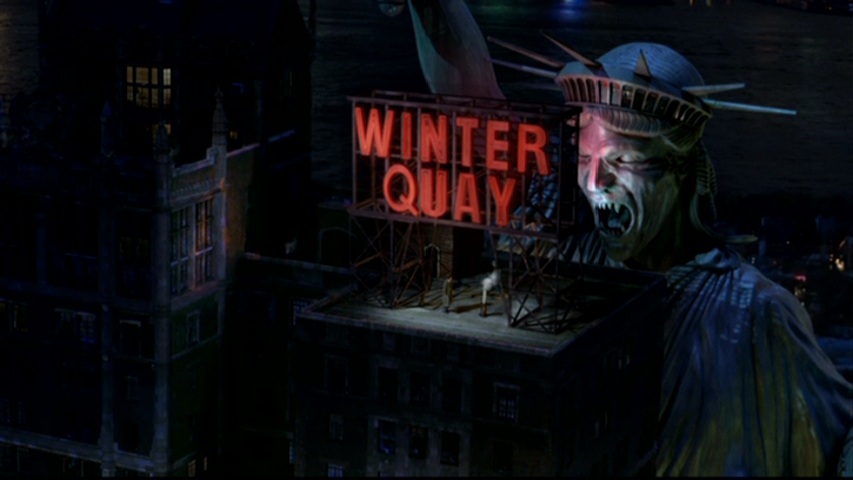
#28 (7.5): The Angels Take Manhattan.

The most powerful Weeping Angel: The Statue of Liberty.

1 episode. Approx. 41 minutes. Written by: Steven Moffat. Directed by: Nick Hurran. Produced by: Marcus Wilson.


THE PLOT:

The Doctor, Amy, and Rory are visiting modern-day New York. The Doctor is reading a book he found in his jacket pocket, a pulp detective book set in 1930's Manhattan. When Rory pops out for coffee, he suddenly appears in the book... and the detective he is speaking with is none other than River Song!

The Weeping Angels have transported Rory back to New York, 1938, in time for him to be captured with River by Grayle (Mike McShane), a crime boss who is a collector of the Angels. Freeing River from Grayle is the work of mere minutes for the Doctor - but those minutes are enough for Rory to be taken to an apartment building used by the Angels as a feeding ground.  Within these seemingly ordinary walls, the trapped residents are used as living batteries, sources of the temporal energy on which the monsters feed!

CHARACTERS:

The Doctor: He always tears out the last page of any book he's reading, so that it never ends. He hates endings, he explains. But this story is all about endings, leaving him struggling futilely to hold back the inevitable. As soon as it becomes apparent that the book is a message from River, he tries to stop Amy from reading ahead because of the danger it poses. If they directly know their own futures, he warns, then those futures will become fixed points that cannot be changed. At Amy's suggestion, he does scan the chapter titles River left as clues. One chapter tells him where Rory is, but another gives him a shock: "Amelia's Last Farewell." The implications leave him shaken, desperate to find a way to change the future but with no plan for actually doing so.

Amy: Amy growing older is something that's been mentioned multiple times this season. When she declined to return to full-time travelling in A Town Called Mercy, she joked that her neighbors would start noticing how much more rapidly she and Rory were aging. The Power of Three planted throwaway reading glasses, which we see her using here. For the Doctor, this is a reminder that his companions are mortal and will end up leaving him one way or another, and Amy recognizes the pain of such reminders. The moment of choice Rory referred to in the previous episode has finally come.  Despite Rory's belief that his love was stronger than hers, Amy's Choice had already shown us the truth years ago: In the end, the only life she wants is one that includes her husband, even if that means their lives can no longer include the Doctor.

Rory: Overshadowed by Amy and River, he doesn't get the sendoff he deserves as a wonderful character in his own right. Arthur Darvill remains as steady and reliable as ever, though, and a rooftop scene near the end allows Rory one strong moment as he finds a solution that even the Doctor can't see.  P. S., an extra scene written by Chris Chibnall, makes much more of his exit, and I highly recommend viewing it online after watching this episode.

River Song: Though she declares herself a "psycopath" (and, amusingly, includes the Doctor in that description as well), she shows strong empathy for both the Doctor and Amy. In a private moment with Amy, she tells her to "never let him see the damage," to never let the Doctor know how much the life he's chosen truly can hurt those around him. As part of that, she adds that it's important to never let the Doctor see them age - something which resonates with both Amy and audience after seeing the Doctor's reaction to age lines near Amy's eyes.


THOUGHTS:

Amy and Rory's exit could hardly be considered a surprise.  Even if you set aside the media coverage, this entire season has portrayed them as having one foot out of the TARDIS.  It's no coincidence that this series of stories has been presented as a string of individual adventures, each one a new reunion for characters who truly went their own way at the end of Series Six but who haven't quite been able to let go of each other.

As Rory observed in The Power of Three, the time has been coming for a final choice. The foreshadowing of the Doctor's conversation with Brian Williams in that very same episode was unmistakable.

The Angels Take Manhattan finally sees this thread cut.  Steven Moffat reportedly struggled with multiple versions of the exit, starting with Daleks before settling on the Angels.  It was a good choice.  The Angels weren't the first monsters Amy faced, but they were the first to genuinely terrify her, to such an extent that when they were seen in one of the rooms of The God Complex she believed they had come for her.  It's appropriate for her finale to see her facing the enemy who had the strongest visceral impact on her.

The Angels' nature also creates story opportunities. Their debut story, Blink, showed them not killing people, but instead sending them back in time to live, age, and die in the past. That is this story's launch point, with the Doctor and Amy getting involved when an Angel sends Rory back in time.  The story adds a memorably ghastly twist to this in the form of the Angels' "battery farm," a hotel in which their victims are kept to live out their lives entirely within one room, with it hinted that they may be sent back in time over and over again to provide sustenance for their captors.

Nick Hurran's direction is almost cinematic. I'm not just referring to the "blockbuster" visuals, such as the Statue of Liberty as a Weeping Angel. Hurran is good at creating atmosphere and building tension. Rory's very long coffee break is a wonderful sequence, building suspense as we look down on him from the vantage of someone watching him. The apartment building that is the Angels' feeding ground is suitably bleak and oppressive, standing like a tacky monument to dread and despair.

All of these elements work, with the character elements working particularly well with the characters' arcs throughout this half-season.  What doesn't entirely work, at least not for me, is some of the plotting.  The story seems designed solely to push the characters to the endpoint.  There is an effort made to create a sense of battling fate... but it isn't as strong as it might be, because the Doctor doesn't really do much to fight.

He isn't a victim of his own overreaching.  He doesn't try some crazy plan that this time fails.  Instead, once he enters the Angels' battery farm, he ceases to try anything beyond simply running.  It feels like there's a missing beat, something that should come after the moment at which the Doctor realizes that only a paradox can save them and before the moment of choice for Rory and Amy on the rooftop.   Without some attempt by the Doctor to grandly subvert fate, the rooftop scene just arrives a bit too quickly, the choice made a bit too easily.

Despite this, The Angels Take Manhattan does a fine job of forcing the Doctor and Amy to, at long last, let go of each other.  It ends with a superb tag, an epilogue which puts a button on not only this story but on all of Amy's run.  This final shot is perfectly judged, as Amy's entire journey is effectively brought full circle.

In the end, I'll admit to slight disappointment that this wasn't a "great" story - but I'd still rate it as a good one.


Overall Rating: 8/10.

Previous Story: The Power of Three
Next Story: The Snowmen 

Search Amazon.com for Doctor Who

Review Index

To receive new review updates, follow me:

On BlueSky:

On Threads:

Sunday, June 16, 2013

#27 (7.4): The Power of Three.

The Trio: Doctor, Amy, and Rory

1 episode. Approx. 41 minutes. Written by: Chris Chibnall. Directed by: Douglas MacKinnon. Produced by: Marcus Wilson.


THE PLOT:

The Doctor is lured back into Amy and Rory's lives when billions of tiny black cubes appear all over the surface of Earth. Along with Kate Stewart (Jemma Redgrave), daughter of the Doctor's old friend Brigadier Lethbridge-Stewart, the Doctor exposes them to multiple tests - all of which yield no result. After days of inactivity, the cubes are declared "provisionally safe" and the Doctor gets bored and leaves, promising to continue monitoring the situation.

A year passes, and the cubes become an accepted part of daily life. People take them into their homes and offices, use them as paperweights and toys. They are simply objects, and become accepted as such.  Which leaves humanity vulnerable. Because while the cubes may be dormant, they are far from dead - and "the slow invasion" is about to begin!


CHARACTERS:

The Doctor:
 In a private moment with Amy, he admits that the reason he keeps coming back is that hers was the first face he saw after his regeneration. Her face was "seared onto (his) hearts," and he's enjoying as much time with her and Rory as possible before they finally decide to stop. That isn't enough to keep him with them when nothing is happening, and it takes less than a week of inactivity for him to become so horribly bored that he simply must do something. He insists to Amy that he isn't running away from life in his travels - He is running as fast as he can in order to try to see everything before it's gone. His explanation rings half-true... but only half-true, as is hinted by the note of desperation that never seems far away from this Doctor's voice.

Amy: I loved both Karen Gillan and Amy pretty much instantly as far back as The Eleventh Hour, and Gillan has gotten better as an actress since. There's a lovely maturity to Amy as she talks with the Doctor about how life with him and life with Rory pull at each other.  As the conversation progresses, it starts to feel as if she's the adult talking to the precocious child that is the Doctor. Then the old enthusiasm of early Season Five Amy shines through as she and the Doctor go to rescue Rory. I love the brief, magical grin that crosses Amy's face just before they go through an interdimensional portal, an expression of childlike glee that is all the more freeing for the contrast with the serious young woman we saw just a few scenes earlier.

Rory: As early as Vampires of Venice, Rory was willing to be absolutely blunt about the Doctor. In that episode, he rebuked the Doctor for the danger his lifestyle created for those around him. In The Girl Who Waited, he raged about the Doctor's carelessness. Here, he lays out for the Doctor that his work and life are important to him, and tells Amy that they will ultimately need to choose between "real life and Doctor life."  He does agree with Amy that he's not ready to choose quite yet, but it seems fairly certain which life he will choose when the moment comes... and Amy increasingly moving to his side.


THOUGHTS:

"Did real life just get started?"

The Power of Three is a very good episode that falls just short of being a great one. It has a clever premise, with the slow invasion that relies on the cubes sitting dormant long enough to become accepted and even mundane. This is one of the most inventive "alien attack" premises Doctor Who has presented in its fifty years: What if an item was brought into everyone's homes only to eventually be revealed as malignant?

Unfortunately, writer Chris Chibnall's script can't match that premise with an equally clever resolution.  The plot progression is enormously clever, and the cubes become quite sinister as we keep cutting back to them to see them more and more ignored by people.  But with any such script, there comes a point where All Must Be Revealed.  The explanation for the cubes is weak, and the way in which the Doctor saves the day feels so absurd that he might as well be using magic to bring the dead back to life - It wouldn't be any less believable than the PseudoScience used here.

That weakness stops this from being the classic it might have been - but it doesn't hurt the overall show as much as you'd think, because the joys of this installment have very little to do with the story. This is a character episode first, an examination of the Ponds and their lives that have been split between "real world and Doctor world."  Judged strictly as a character episode, it soars.  Amy and Rory's dilemma is presented in a way that feels completely convincing. The Doctor is also given an extra layer of scrutiny, from his admission to Amy about why he keeps coming back to her and Rory to his scene with Rory's father, Brian (Mark Williams), in which he discusses the ways his past companions have left him.

The splendid character scenes, the long period covered by the episode (which takes place over the course of a full year), and the cleverness of the invasion premise all make The Power of Three a success.  If the ending was as strong as the rest of it, this would be the best episode thus far in Series Seven.  As it stands, it still manages to be a respectable second-best.


Overall Rating: 8/10.

Previous Story: A Town Called Mercy
Next Story: The Angels Take Manhattan

Search Amazon.com for Doctor Who

Review Index

To receive new review updates, follow me:

On BlueSky:

On Threads:
Saturday, June 8, 2013

#26 (7.3): A Town Called Mercy.

The Doctor prepares for a showdown at high noon.

1 episode. Approx. 44 minutes. Written by: Toby Whithouse. Directed by: Saul Metzstein. Produced by: Marcus Wilson.


THE PLOT:

The Doctor picks up Amy and Rory again, this time to take them to Mexico for the Day of the Dead festival. The TARDIS being what it is, they instead find themselves outside the town of Mercy in the American West, not long after the Civil War. The Doctor's attention is immediately drawn to the "Keep Out" sign at the town border, to the anachronistic electric lighting, and to the suspicious stares he and his companions draw as they walk through the town. "Did someone have a peek at my Christmas list?" the Doctor exults.

Isaac (Ben Browder), the town's marshall, informs them that the residents have been prisoners for the past three weeks. A mysterious Gunslinger (Andrew Brooke), a cyborg armed with a laser cannon, has threatened to kill anyone attempting to leave until Mercy turns over "the doctor" - an alien named Kahler-Jex (Adrian Scarborough). Jex's spaceship crashed some years earlier, and he was taken in by the townspeople. Ever since, he has worked as their physician.

The Doctor agrees to help. But when he stumbles across Jex's crashed ship and activates its computer systems, he learns that there's far more to the story than had been revealed. Jex is a war criminal, who experimented on subjects to create an army of cyborgs. The Gunslinger is not just a villain - He is also Jex's sole surviving victim, out for revenge at any cost!


CHARACTERS:

The Doctor: OK, perhaps the Doctor's ruthlessness at the end of Dinosaurs on a Spaceship wasn't just an uncomfortably out-of-character moment. We see another moment of violence here, when he prepares to angrily send Jex to his death. Amy is there to call him on it this time, wondering what has happened to the good man she knew and commenting that he's been traveling alone for too long. This season's Doctor seems perpetually on the brink of crossing a terrible line, much like the line he throws Jex across in sentencing him to die. Amy and Isaac pull him back from the brink this time, and Jex eventually shows genuine honor at the end, but there's no sense that the Doctor's anger issues have been resolved.

Amy: In the previous story, she got to act as sort of a Doctor figure herself. Here, she is very much in the companion role - but also very much in the companions' original role, acting as the Doctor's conscience. When the Doctor is ready to simply give Jex over to the Gunslinger, Amy is the one who stops him, reminding him that he is better than this.

Rory: Gets the least to do of the three regulars. He is, not for the first time, the voice of pragmatism. When the Doctor is ready to eject Jex, Rory supports that choice. When Amy asks if they're really going to let the Doctor do this, his response is coldly pragmatic: "Save us all? Yeah, I really am." However, once the decision is made to save Jex and stop the Gunslinger, Rory doesn't question it and is fully on board with assisting.


THOUGHTS:

"You're both good men. You just forget it sometimes."
-Isaac, Marshall of the Town of Mercy, of the Doctor and Jex.

A Town Called Mercy is another script by Toby Whithouse, who wrote my second-favorite non-Moffat story of last season, The God Complex. That story was notable for its examination of the Doctor and his view of himself versus his companions' view of him. This story isn't quite as strong, but it does see Whithouse once again tackling the Doctor as he relates to those around him.

This is most clear in the parallels drawn between the Doctor and Jex. Jex taunts the Doctor by observing how similar they are in many ways: Both scientists, both men who have tried to help others but have also witnessed true darkness. That runs right down to them both having done terrible things in order to end wars. Seeing himself in Jex makes it hard for the Doctor to be objective as he considers the implications of what the other man has done.

The Gunslinger is also a parallel to the Doctor: A man who wanted to help secure peace, and instead was turned into a weapon at great personal cost. Like Jex, he does his own penance for his misdeeds, and the bookend narration starts by apparently describing the Doctor and ends by describing the Gunslinger. In all three men, we see the worst and best they have to offer.

The western setting allows Whithouse to have some fun playing with genre conventions. Several stereotypical western moments are recreated. The main plot, with a town cut off by an external threat, is reminiscent of Rio Bravo. The deadline the Gunslinger gives before he will come to town to take Jex over the Doctor's dead body is more than a little like the one in High Noon. There's even a scene in which the Doctor faces down a lynch mob while protecting the prisoner. The pastische goes just far enough to be amusing, but not so far as to descend into self-parody. The show is self-aware in structuring itself as a western, but never stops being a proper Doctor Who story as well.

A final note that seems to apply to this whole half-season: The Doctor, Amy, and Rory are not traveling together full-time and have not been since The God Complex. Every story this season has been an isolated adventure, with them reunited for one adventure with the Doctor dropping them back at their home at the end. The last story revealed that it had been months between visits, and this story ends with Amy asking the Doctor to give them some time before visiting again. As Amy observed in the last story, it's almost as if the Doctor is weaning the Ponds off him (or vice-versa?). This gradual distancing of the Doctor and his companions is an interesting departure from the usual exit, and I'll be very interested to see its final endpoint.

In, I suppose, two more episodes.


Overall Rating: 7/10.

Previous Story: Dinosaurs on a Spaceship
Next Story: The Power of Three

Search Amazon.com for Doctor Who

Review Index

To receive new review updates, follow me:

On BlueSky:

On Threads: