 |
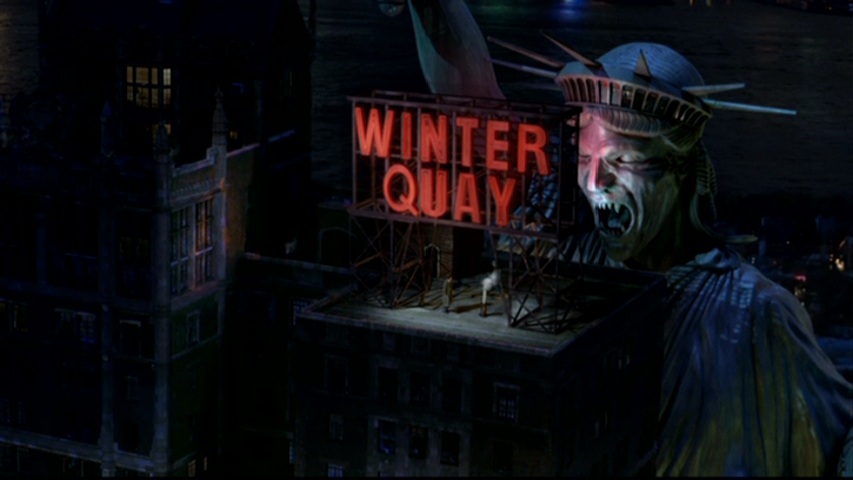
| The most powerful Weeping Angel: The Statue of Liberty. |
1 episode. Approx. 41 minutes. Written by: Steven Moffat. Directed by: Nick Hurran. Produced by: Marcus Wilson.
THE PLOT:
The Doctor, Amy, and Rory are visiting modern-day New York. The Doctor is reading a book he found in his jacket pocket, a pulp detective book set in 1930's Manhattan. When Rory pops out for coffee, he suddenly appears in the book... and the detective he is speaking with is none other than River Song!
The Weeping Angels have transported Rory back to New York, 1938, in time for him to be captured with River by Grayle (Mike McShane), a crime boss who is a collector of the Angels. Freeing River from Grayle is the work of mere minutes for the Doctor - but those minutes are enough for Rory to be taken to an apartment building used by the Angels as a feeding ground. Within these seemingly ordinary walls, the trapped residents are used as living batteries, sources of the temporal energy on which the monsters feed!
CHARACTERS:
The Doctor: He always tears out the last page of any book he's reading, so that it never ends. He hates endings, he explains. But this story is all about endings, leaving him struggling futilely to hold back the inevitable. As soon as it becomes apparent that the book is a message from River, he tries to stop Amy from reading ahead because of the danger it poses. If they directly know their own futures, he warns, then those futures will become fixed points that cannot be changed. At Amy's suggestion, he does scan the chapter titles River left as clues. One chapter tells him where Rory is, but another gives him a shock: "Amelia's Last Farewell." The implications leave him shaken, desperate to find a way to change the future but with no plan for actually doing so.
Amy: Amy growing older is something that's been mentioned multiple times this season. When she declined to return to full-time travelling in A Town Called Mercy, she joked that her neighbors would start noticing how much more rapidly she and Rory were aging. The Power of Three planted throwaway reading glasses, which we see her using here. For the Doctor, this is a reminder that his companions are mortal and will end up leaving him one way or another, and Amy recognizes the pain of such reminders. The moment of choice Rory referred to in the previous episode has finally come. Despite Rory's belief that his love was stronger than hers, Amy's Choice had already shown us the truth years ago: In the end, the only life she wants is one that includes her husband, even if that means their lives can no longer include the Doctor.
Rory: Overshadowed by Amy and River, he doesn't get the sendoff he deserves as a wonderful character in his own right. Arthur Darvill remains as steady and reliable as ever, though, and a rooftop scene near the end allows Rory one strong moment as he finds a solution that even the Doctor can't see. P. S., an extra scene written by Chris Chibnall, makes much more of his exit, and I highly recommend viewing it online after watching this episode.
River Song: Though she declares herself a "psycopath" (and, amusingly, includes the Doctor in that description as well), she shows strong empathy for both the Doctor and Amy. In a private moment with Amy, she tells her to "never let him see the damage," to never let the Doctor know how much the life he's chosen truly can hurt those around him. As part of that, she adds that it's important to never let the Doctor see them age - something which resonates with both Amy and audience after seeing the Doctor's reaction to age lines near Amy's eyes.
THOUGHTS:
Amy and Rory's exit could hardly be considered a surprise. Even if you set aside the media coverage, this entire season has portrayed them as having one foot out of the TARDIS. It's no coincidence that this series of stories has been presented as a string of individual adventures, each one a new reunion for characters who truly went their own way at the end of Series Six but who haven't quite been able to let go of each other.
As Rory observed in The Power of Three, the time has been coming for a final choice. The foreshadowing of the Doctor's conversation with Brian Williams in that very same episode was unmistakable.
The Angels Take Manhattan finally sees this thread cut. Steven Moffat reportedly struggled with multiple versions of the exit, starting with Daleks before settling on the Angels. It was a good choice. The Angels weren't the first monsters Amy faced, but they were the first to genuinely terrify her, to such an extent that when they were seen in one of the rooms of The God Complex she believed they had come for her. It's appropriate for her finale to see her facing the enemy who had the strongest visceral impact on her.
The Angels' nature also creates story opportunities. Their debut story, Blink, showed them not killing people, but instead sending them back in time to live, age, and die in the past. That is this story's launch point, with the Doctor and Amy getting involved when an Angel sends Rory back in time. The story adds a memorably ghastly twist to this in the form of the Angels' "battery farm," a hotel in which their victims are kept to live out their lives entirely within one room, with it hinted that they may be sent back in time over and over again to provide sustenance for their captors.
Nick Hurran's direction is almost cinematic. I'm not just referring to the "blockbuster" visuals, such as the Statue of Liberty as a Weeping Angel. Hurran is good at creating atmosphere and building tension. Rory's very long coffee break is a wonderful sequence, building suspense as we look down on him from the vantage of someone watching him. The apartment building that is the Angels' feeding ground is suitably bleak and oppressive, standing like a tacky monument to dread and despair.
All of these elements work, with the character elements working particularly well with the characters' arcs throughout this half-season. What doesn't entirely work, at least not for me, is some of the plotting. The story seems designed solely to push the characters to the endpoint. There is an effort made to create a sense of battling fate... but it isn't as strong as it might be, because the Doctor doesn't really do much to fight.
He isn't a victim of his own overreaching. He doesn't try some crazy plan that this time fails. Instead, once he enters the Angels' battery farm, he ceases to try anything beyond simply running. It feels like there's a missing beat, something that should come after the moment at which the Doctor realizes that only a paradox can save them and before the moment of choice for Rory and Amy on the rooftop. Without some attempt by the Doctor to grandly subvert fate, the rooftop scene just arrives a bit too quickly, the choice made a bit too easily.
Despite this, The Angels Take Manhattan does a fine job of forcing the Doctor and Amy to, at long last, let go of each other. It ends with a superb tag, an epilogue which puts a button on not only this story but on all of Amy's run. This final shot is perfectly judged, as Amy's entire journey is effectively brought full circle.
In the end, I'll admit to slight disappointment that this wasn't a "great" story - but I'd still rate it as a good one.
Overall Rating: 8/10.
Previous Story: The Power of Three
Next Story: The Snowmen
Search Amazon.com for Doctor Who
Review Index
To receive new review updates, follow me:
On BlueSky:

On Threads:


