Showing posts with label Nick Hurran. Show all posts

Sunday, June 23, 2013

#28 (7.5): The Angels Take Manhattan.

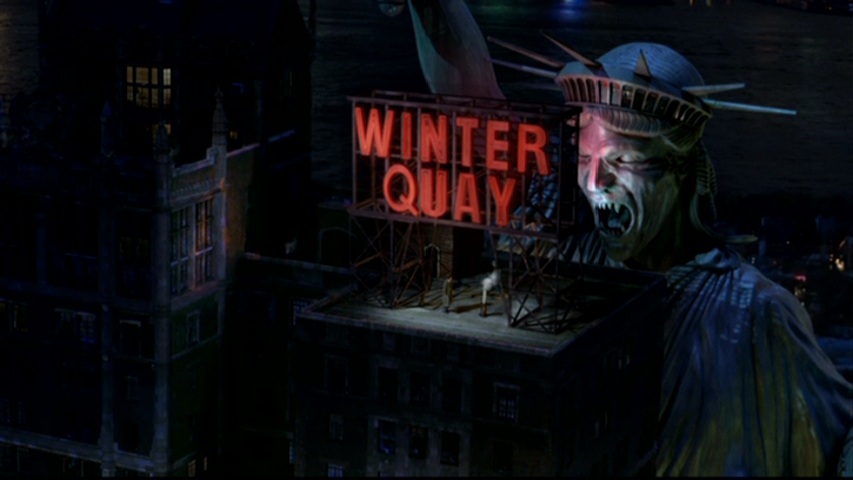
The most powerful Weeping Angel: The Statue of Liberty.

1 episode. Approx. 41 minutes. Written by: Steven Moffat. Directed by: Nick Hurran. Produced by: Marcus Wilson.


THE PLOT:

The Doctor, Amy, and Rory are visiting modern-day New York. The Doctor is reading a book he found in his jacket pocket, a pulp detective book set in 1930's Manhattan. When Rory pops out for coffee, he suddenly appears in the book... and the detective he is speaking with is none other than River Song!

The Weeping Angels have transported Rory back to New York, 1938, in time for him to be captured with River by Grayle (Mike McShane), a crime boss who is a collector of the Angels. Freeing River from Grayle is the work of mere minutes for the Doctor - but those minutes are enough for Rory to be taken to an apartment building used by the Angels as a feeding ground.  Within these seemingly ordinary walls, the trapped residents are used as living batteries, sources of the temporal energy on which the monsters feed!

CHARACTERS:

The Doctor: He always tears out the last page of any book he's reading, so that it never ends. He hates endings, he explains. But this story is all about endings, leaving him struggling futilely to hold back the inevitable. As soon as it becomes apparent that the book is a message from River, he tries to stop Amy from reading ahead because of the danger it poses. If they directly know their own futures, he warns, then those futures will become fixed points that cannot be changed. At Amy's suggestion, he does scan the chapter titles River left as clues. One chapter tells him where Rory is, but another gives him a shock: "Amelia's Last Farewell." The implications leave him shaken, desperate to find a way to change the future but with no plan for actually doing so.

Amy: Amy growing older is something that's been mentioned multiple times this season. When she declined to return to full-time travelling in A Town Called Mercy, she joked that her neighbors would start noticing how much more rapidly she and Rory were aging. The Power of Three planted throwaway reading glasses, which we see her using here. For the Doctor, this is a reminder that his companions are mortal and will end up leaving him one way or another, and Amy recognizes the pain of such reminders. The moment of choice Rory referred to in the previous episode has finally come.  Despite Rory's belief that his love was stronger than hers, Amy's Choice had already shown us the truth years ago: In the end, the only life she wants is one that includes her husband, even if that means their lives can no longer include the Doctor.

Rory: Overshadowed by Amy and River, he doesn't get the sendoff he deserves as a wonderful character in his own right. Arthur Darvill remains as steady and reliable as ever, though, and a rooftop scene near the end allows Rory one strong moment as he finds a solution that even the Doctor can't see.  P. S., an extra scene written by Chris Chibnall, makes much more of his exit, and I highly recommend viewing it online after watching this episode.

River Song: Though she declares herself a "psycopath" (and, amusingly, includes the Doctor in that description as well), she shows strong empathy for both the Doctor and Amy. In a private moment with Amy, she tells her to "never let him see the damage," to never let the Doctor know how much the life he's chosen truly can hurt those around him. As part of that, she adds that it's important to never let the Doctor see them age - something which resonates with both Amy and audience after seeing the Doctor's reaction to age lines near Amy's eyes.


THOUGHTS:

Amy and Rory's exit could hardly be considered a surprise.  Even if you set aside the media coverage, this entire season has portrayed them as having one foot out of the TARDIS.  It's no coincidence that this series of stories has been presented as a string of individual adventures, each one a new reunion for characters who truly went their own way at the end of Series Six but who haven't quite been able to let go of each other.

As Rory observed in The Power of Three, the time has been coming for a final choice. The foreshadowing of the Doctor's conversation with Brian Williams in that very same episode was unmistakable.

The Angels Take Manhattan finally sees this thread cut.  Steven Moffat reportedly struggled with multiple versions of the exit, starting with Daleks before settling on the Angels.  It was a good choice.  The Angels weren't the first monsters Amy faced, but they were the first to genuinely terrify her, to such an extent that when they were seen in one of the rooms of The God Complex she believed they had come for her.  It's appropriate for her finale to see her facing the enemy who had the strongest visceral impact on her.

The Angels' nature also creates story opportunities. Their debut story, Blink, showed them not killing people, but instead sending them back in time to live, age, and die in the past. That is this story's launch point, with the Doctor and Amy getting involved when an Angel sends Rory back in time.  The story adds a memorably ghastly twist to this in the form of the Angels' "battery farm," a hotel in which their victims are kept to live out their lives entirely within one room, with it hinted that they may be sent back in time over and over again to provide sustenance for their captors.

Nick Hurran's direction is almost cinematic. I'm not just referring to the "blockbuster" visuals, such as the Statue of Liberty as a Weeping Angel. Hurran is good at creating atmosphere and building tension. Rory's very long coffee break is a wonderful sequence, building suspense as we look down on him from the vantage of someone watching him. The apartment building that is the Angels' feeding ground is suitably bleak and oppressive, standing like a tacky monument to dread and despair.

All of these elements work, with the character elements working particularly well with the characters' arcs throughout this half-season.  What doesn't entirely work, at least not for me, is some of the plotting.  The story seems designed solely to push the characters to the endpoint.  There is an effort made to create a sense of battling fate... but it isn't as strong as it might be, because the Doctor doesn't really do much to fight.

He isn't a victim of his own overreaching.  He doesn't try some crazy plan that this time fails.  Instead, once he enters the Angels' battery farm, he ceases to try anything beyond simply running.  It feels like there's a missing beat, something that should come after the moment at which the Doctor realizes that only a paradox can save them and before the moment of choice for Rory and Amy on the rooftop.   Without some attempt by the Doctor to grandly subvert fate, the rooftop scene just arrives a bit too quickly, the choice made a bit too easily.

Despite this, The Angels Take Manhattan does a fine job of forcing the Doctor and Amy to, at long last, let go of each other.  It ends with a superb tag, an epilogue which puts a button on not only this story but on all of Amy's run.  This final shot is perfectly judged, as Amy's entire journey is effectively brought full circle.

In the end, I'll admit to slight disappointment that this wasn't a "great" story - but I'd still rate it as a good one.


Overall Rating: 8/10.

Previous Story: The Power of Three
Next Story: The Snowmen 

Search Amazon.com for Doctor Who

Review Index

To receive new review updates, follow me:

On BlueSky:

On Threads:

Sunday, May 26, 2013

#24 (7.1): Asylum of the Daleks

The Doctor rescues Amy from a Dalek trap.

1 episode. Approx. 45 minutes. Written by: Steven Moffat. Directed by Nick Hurran: Produced by: Marcus Wilson.


THE PLOT:

The Doctor, Amy, and Rory have gone their separate ways - but a Dalek trap thrusts them back together. They are snatched from their daily lives and transported to a massive Dalek spaceship orbiting a planet used an asylum for Daleks too insane for even their society to control. Now they are receiving a transmission from inside the asylum: the Habanera Aria, played over and over by Oswin Oswald (Jenna Louise Coleman), a survivor of a starliner which crashed onto the planet a year ago.

The crash damaged to force field surrounding the Asylum, making escape by the inmates possible. The field isn't so badly damaged, however, for the Daleks to simply destroy the planet. A small team will need to be transported to the Asylum to deactivate the defenses from within... and that is where the Doctor comes in.

"You're going to fire me at a planet?" the Doctor realizes, aghast. "That's your plan? I get fired at a planet and expected to fix it?"

A fix that will be complicated not only by the Dalek inmates, but also by a nanogene cloud which transforms all organic tissue into Dalek life. The Doctor and his companions are protected by wrist-bands the Daleks provide them with - but what is protecting the apparently un-converted Oswin? And just where is she getting the milk and eggs for her series of failed souffles?


CHARACTERS:

The Doctor: Recognizes almost immediately that the distress call he is responding to is actually a trap - though "almost immediately" is still too late to actually avoid it. He is astonished that the Daleks regard him as their predator, though it makes sense given how many times he has destroyed both them and their plans. The Doctor continues to show a tendency to obsess about apparently irrelevent details - such as Oswin's souffles - only for those details to be the key to the major puzzle, and he seems to place as much importance on solving the problems with Amy and Rory's marriage as on solving the problems connected to the Daleks.

Amy: When the Doctor tells her not to be scared, she replies that she isn't - She's actually quite missed this! She seems to be having a genuinely good time at being reunited with him, which makes it karmically inevitable that she will be the one put in the greatest danger. It's clear early on that despite the impending divorce that was clearly her idea, she still has feelings for Rory. She is clearly hurt by his bruising words to her when they meet to sign divorce papers; and as soon as they are separated on the planet, her first thought is to search for him.

Rory: Though he gets less to do this episode than in many of last year's installments, Rory remains the most completely relatable character the new series has ever provided. He's a good man and very dependable, but also has a way of just finding himself in the worst possible place at the worst possible time. He does believe that a fundamental truth of his relationship with Amy is that he loves her more than she loves him - a belief which probably hasn't helped with their marriage difficulties.

Oswin: Jenna-Louise Coleman, who will portray the Doctor's next companion, gets her introduction here. She makes a strong first impression, showing a lively screen presence. She captures the quirkiness needed to make Steven Moffat's clever, rapid-fire dialogue feel like something that might actually come out of the mouth of a human being. The character is basically in template form here: pretty, young, computer genius... Think Wendy Padbury's Zoe without the innocence. There's nothing in this particular story to indicate that she's a future companion (quite the opposite), but since that decision had already been made when this was shot, I look forward to seeing exactly how she'll be re-integrated later.

Daleks: They have a Parliament, complete with a Prime Minister - a Dalek creature who is visible, rather than hidden behind a casing. The Daleks have not destroyed the inmates of the Asylum, because they find the pure hatred of the inmates "beautiful," a statement which earns renewed revulsion from the Doctor. They have grown stronger from fighting the Doctor - something he knows all too well, but he cannot stop battling them when he encounters them. What's he supposed to do? Leave them to wipe out a settlement to avoid strengthening them in conflict? The finale offers him a solution, at least for the time being... Though I suspect it will prove a temporary one.


THOUGHTS:

I was not particularly looking forward to Asylum of the Daleks. After a promising debut in Series One's Dalek, which re-established them as a true menace by showing a single Dalek as near unstoppable, their follow-up appearances have grown steadily weaker and sillier, culminating in the disaster of Victory of the Daleks in Series Five. It was a relief to see them get a year off in Series Six.

As it turns out, I needn't have worried, as this turns out to be a terrific kickoff to the new season.

It starts with what's become a Moffat signature: A fast, clever, visually startling opening. We open with a fantastic visual of the war-torn Skaro, the Dalek homeworld, complete with a giant statue of a Dalek. The Doctor meets with Darla (Anamaria Marinca), who pleads with him to help free her daughter from a Dalek prison camp. We get all set for one episode - only to get a fast reversal, as it turns out this entire meeting is a trap. Quick cut to Amy and Rory, re-establishing them as characters and setting up the difficulties in their marriage, before they are also ensnared. Then a scene aboard the Dalek spaceship in which they all expect to be exterminated before the Daleks plead with the Doctor to "Save us... Save us!"


Smash to credits, and the story has been set up, complete with expectations subverted twice, all within a span of about six minutes.

The story retains a rapid, roller-coaster pace throughout. It's not free of silliness by any means... but a Moffat script is nothing if not self-aware, and the sillier moments are actually used to feed the energy and momentum, keeping this effortlessly entertaining from start to finish.

A superb season opener. If the rest of Series Seven can maintain this level, I will be a very happy viewer.

Overall Rating: 9/10.

Previous Story: Pond Life
Next Story: Dinosaurs on a Spaceship

Search Amazon.com for Doctor Who

Review Index

To receive new review updates, follow me:

On BlueSky:

On Threads:

Monday, November 19, 2012

#20 (6.11): The God Complex.

The Doctor has a lapse of confidence.

1 episode. Approx. 48 minutes. Written by: Toby Whithouse. Directed by: Nick Hurran. Produced by: Marcus Wilson.


THE PLOT

In the corridors of a hotel, as muzak blares over the speaker system, a monster stalks the halls. The people trapped inside are not guests. They are people from all across time and space, taken from their ordinary lives to this structure - a place that is not on Earth, in which the walls and corridors move. Every person has a room. Inside that room, their worst nightmare waits. And once they have found their nightmare, they are ready: First to "praise him," then to become food for the beast.

Into this fluorescent labyrinth come the Doctor, Amy, and Rory. They quickly meet the "hotel's" current group of victims, who have been wandering the corridors for two days. They are confused, tired, and terrified.  But the Doctor is here now, so there's no need for any of them to be afraid. He will unravel the mystery and defeat the monster, and everyone will be able to go home safely. There's nothing to worry about. After all, he's the Doctor.

"Praise him."


CHARACTERS

The Doctor: So what was in his room? Whatever it was, it and Rita (Amara Karan)'s words to him clearly are leading him to reassess his nature. We've already seen a tendency toward self-loathing in this Doctor. That tendency is built on here, as he seems to renounce any claim toward goodness. "I'm not a hero," he tells Amy. "I really am just a madman in a box... It's time to see each other as we really are."

Amy: Has absolute faith in the Doctor to save them. She has a compassionate scene early on with Gibbis (David Walliams), a cowardly alien from the most invaded planet in the galaxy. It's a nice scene on its own, well-played by Karen Gillan.  The scene takes on added meaning in retrospect, though, when you can recognize it as foreshadowing. Amy's nightmare is of herself as a child, waiting for the Doctor to come back for her. It was the first time the Doctor failed her - and also the first time they met.

Rory: Still the most grounded of the time travelers, and still the most decent. His reaction to one death is to look at that person's picture on the wall and reflect about how much it must have taken for that person to overcome a stutter in his past. "Not all victories are about saving the universe," he says quietly, a statement that has to set the Doctor to thinking.


THOUGHTS

The God Complex is another visually superb episode. It probably wasn't a particularly expensive one. The hotel sets are fairly standard, and much of the running time occurs in a single corridor and staircase, both of which are reused throughout. But these sets are wonderfully shot.  Director Nick Hurran employs an array of camera techniques, from tilted angles to speeded-up motion, to lend the proceedings a vaguely surreal atmosphere.

The production is matched by an excellent script, the best that Toby Whithouse has yet written for the series. This script sees him combining plot and character elements just about perfectly. The character material and the story don't compete for attention.  They feed each other, the characterization of both regulars and guest cast an inherent component of the story itself.

The regulars are superbly characterized, in a way that builds on elements that have run through the entire season (and in Amy's case, since her introduction). The guest characters are also engaging.  Amara Karan's Rita is the only completely 3-dimensional one among them, but all of the "monster fodder" manage to make an impression during their time on-screen. Each character also provides some new hint, giving the Doctor a trail of crumbs to lead him to the truth - even if he gets there a bit later than he might have liked.

Like the last couple of episodes, The God Complex indulges in emotion at the end. However, while I felt those episodes overegged the sentiment, here it's all balanced just right. The Doctor's scene with Amy/Amelia in "her room" works for me in a way that Old Amy's self-sacrifice didn't. For one thing, the Doctor's speech is much shorter, saying only as much as is necessary to achieve the goal. Also, instead of being used to wrap things up neatly and spare the regulars mess, as was the case in The Girl Who Waited, here the emotional moments make things messier. The Doctor resolves the situation, but at severe cost to himself.

The monster's final words hit home, for both Doctor and viewer. As does the episode's final shot, with the Doctor in his TARDIS - increasingly isolated, increasingly disillusioned with himself. It's an interesting place to leave a man who has usually been defined by his confidence, and I'm eager to see where the story goes from here.


Rating: 9/10.

Previous Episode: The Girl Who Waited
Next Episode: Closing Time

Search Amazon.com for Doctor Who

Review Index

To receive new review updates, follow me:

On BlueSky:

On Threads:

Monday, October 8, 2012

#19 (6.10): The Girl Who Waited.

Amy in Wonderland.

1 episode. Approx. 45 minutes. Written by: Tom MacRae. Directed by: Nick Hurran. Produced by: Marcus Wilson.


THE PLOT

The Doctor brings Amy and Rory to the planet Apalapucia, a pleasure planet where he promises a fantastic holiday. But when a delayed Amy becomes separated from the others, it doesn't take long for the Doctor and Rory to realize that she's caught in a separate time stream. Hours, days, even weeks are passing for her while only minutes go by for them. That's when they learn that the planet suffered a plague whose victims will die within a day. Out of desperation, the people of Apalapucia used their technology to stretch that day so that it would last for a lifetime - by putting the afflicted into "slowed down" time streams.

The Doctor quickly puts together a lash-up to find Amy, and brings the TARDIS into her time-stream. He can't go himself, as Time Lords are susceptible to this disease - but humans are not, so he sends Rory to find and recover her. But the Doctor, who has kept Amy waiting so many times in the past, has gotten the times wrong again. Decades have passed for her. Instead of his lovely bride, Rory finds an aging, bitter Amy, filled with hatred at the Doctor for ruining her life!


CHARACTERS

The Doctor: The teaser provides a pretty good summation of this Doctor's character. The TARDIS materializes in a featureless room with a single door. Amy wants to take a moment to get something from the TARDIS. All the Doctor has to do to avoid the crisis is to wait for just one or two minutes. But there's a door in front of him. Of course he's going to go through it, and of course he's not going to wait. The last part of the episode sums up the other part of his character, the darker part. He can save his friend, the young Amy who worships him - but not if he saves the older Amy, the one he failed. Of course he's going to want to save the younger Amy, and of course he has the ruthlessness needed to ignore the cries of the older Amy. In these scenes, Matt Smith's impassiveness is downright chilling.

Amy: Karen Gillan is very good as the older Amy, transforming everything from her style of line delivery to her body language to show someone constantly on guard, for whom paranoia has simply become a way of life. The older Amy's overriding self-interest is off-putting, but it does fit. She has been entirely alone save for killer robots for 36 years. Of course her self-preservation instincts and her selfish qualities will be magnified - Her entire world has been devoted entirely to keeping herself alive! Her love for Rory shines through in both older and younger variants, though, as she ultimately agrees to help recover the younger Amy. Not for her younger self, who is just a memory to her; not for the Doctor, whom she now despises; only for Rory.

Rory: In Rory's first trip in the TARDIS, he called the Doctor on the danger he posed to those he traveled with. That is echoed here, when he again calls the Doctor on his carelessness, demanding to know why he didn't plan his trip to this planet better. When the Doctor blithely replies that "careful" isn't the way he travels, Rory thunders back, "Then I don't want to travel with you!" Really, this is as much Rory's episode as Amy's, maybe more. He gets put through the wringer here, having to contend with the idea of losing his wife to a stupid accident, then of gaining her back as a hardened middle-aged warrior. In the end, the Doctor calls on him to make a choice that just isn't in his nature, and he can't quite do it - at least, not without the older Amy's help. After the events of this episode, I can't help but think that Rory's days on the TARDIS are numbered. I don't see how the writers could sidestep his obvious readiness to end these travels, which have become less a dream and more a nightmare for him.


THOUGHTS

The Girl Who Waited is a good episode that might have been a great one. The story concept is intriguing, and it manages to present a "Doctor-lite" episode in such a way that you barely notice the Doctor's minimized screen time. The regulars are all on top form, and the production is one of the most visually arresting of a season that's been generally outstanding in this regard.

The visual element deserves particular praise. The white-on-white rooms and corridors, reminiscent of the void from The Mind Robber's first episode, arrested my attention immediately. The garden set is also quite lovely, and you can see how this centre could be a nice place to spend a lot of time - if not for the threat of the well-meaning but deadly robots.

The first half is terrific. The dilemma is established quickly, and it's interesting and involving. Amy's "first day" in the centre is sublime storytelling, as she moves from enjoying the chance to walk around and explore the garden to running and hiding in terror from the robots. The pace slows a bit once Rory encounters the older Amy, but the narrative remains intriguing and Amy's transformation to a bitter woman is startling, wonderfully acted by Karen Gillan and convincing in terms of the plot. All of this works, even the younger Amy's plea for the older Amy's help "for Rory's sake."

What doesn't quite work for me is the ending. This season has shown a regrettable tendency to overdo sentiment. The Rebel Flesh had its suspense/horror aspects undermined by an overdose of sentiment near the end. Any potential Night Terrors had was smothered by a saccharine ending in which the Doctor made a bad speech to inspire the little boy's father to go to the rescue. And now this otherwise excellent episode stumbles at the end, in my opinion, by falling into the same trap.

Don't get me wrong, a touch of sentiment used in just the right place can be very effective. Just witness the closing scenes of the previous season finale for a good example. But self-sacrifice is an overused trope in Doctor Who to start with, and older Amy's defining trait is her heightened sense of self-preservation. Imagine an ending in which older Amy continued to bang on the TARDIS door, begging and pleading for her life as first the TARDIS disappeared, then the robots closed in on her. To me, that would have been more effective than having yet another sentimental speech in a season already overloaded with such speeches.

This is still a good episode. I just wish it had chosen a different path, or at least been more subdued about the path it chose, at the end.


Rating: 7/10.

Previous Story: Night Terrors
Next Story: The God Complex 

Search Amazon.com for Doctor Who

Review Index

To receive new review updates, follow me:

On BlueSky:

On Threads: