Showing posts with label Arthur Darvill. Show all posts

Sunday, June 23, 2013

#28 (7.5): The Angels Take Manhattan.

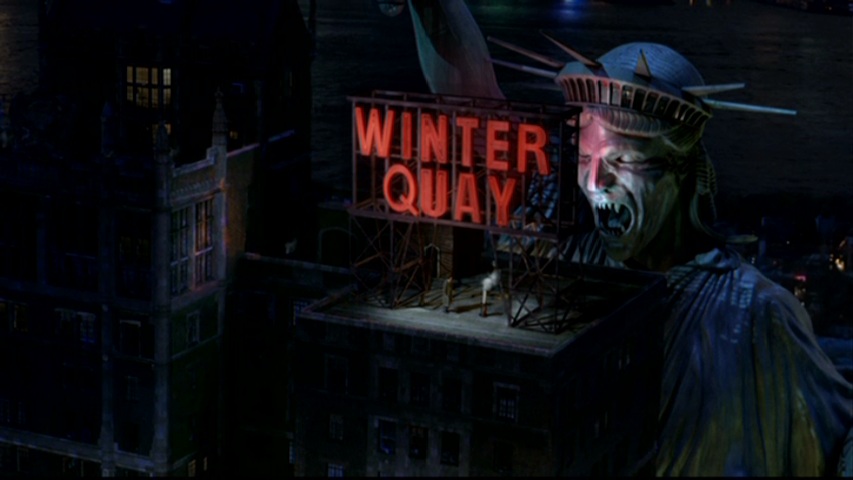
The most powerful Weeping Angel: The Statue of Liberty.

1 episode. Approx. 41 minutes. Written by: Steven Moffat. Directed by: Nick Hurran. Produced by: Marcus Wilson.


THE PLOT:

The Doctor, Amy, and Rory are visiting modern-day New York. The Doctor is reading a book he found in his jacket pocket, a pulp detective book set in 1930's Manhattan. When Rory pops out for coffee, he suddenly appears in the book... and the detective he is speaking with is none other than River Song!

The Weeping Angels have transported Rory back to New York, 1938, in time for him to be captured with River by Grayle (Mike McShane), a crime boss who is a collector of the Angels. Freeing River from Grayle is the work of mere minutes for the Doctor - but those minutes are enough for Rory to be taken to an apartment building used by the Angels as a feeding ground.  Within these seemingly ordinary walls, the trapped residents are used as living batteries, sources of the temporal energy on which the monsters feed!

CHARACTERS:

The Doctor: He always tears out the last page of any book he's reading, so that it never ends. He hates endings, he explains. But this story is all about endings, leaving him struggling futilely to hold back the inevitable. As soon as it becomes apparent that the book is a message from River, he tries to stop Amy from reading ahead because of the danger it poses. If they directly know their own futures, he warns, then those futures will become fixed points that cannot be changed. At Amy's suggestion, he does scan the chapter titles River left as clues. One chapter tells him where Rory is, but another gives him a shock: "Amelia's Last Farewell." The implications leave him shaken, desperate to find a way to change the future but with no plan for actually doing so.

Amy: Amy growing older is something that's been mentioned multiple times this season. When she declined to return to full-time travelling in A Town Called Mercy, she joked that her neighbors would start noticing how much more rapidly she and Rory were aging. The Power of Three planted throwaway reading glasses, which we see her using here. For the Doctor, this is a reminder that his companions are mortal and will end up leaving him one way or another, and Amy recognizes the pain of such reminders. The moment of choice Rory referred to in the previous episode has finally come.  Despite Rory's belief that his love was stronger than hers, Amy's Choice had already shown us the truth years ago: In the end, the only life she wants is one that includes her husband, even if that means their lives can no longer include the Doctor.

Rory: Overshadowed by Amy and River, he doesn't get the sendoff he deserves as a wonderful character in his own right. Arthur Darvill remains as steady and reliable as ever, though, and a rooftop scene near the end allows Rory one strong moment as he finds a solution that even the Doctor can't see.  P. S., an extra scene written by Chris Chibnall, makes much more of his exit, and I highly recommend viewing it online after watching this episode.

River Song: Though she declares herself a "psycopath" (and, amusingly, includes the Doctor in that description as well), she shows strong empathy for both the Doctor and Amy. In a private moment with Amy, she tells her to "never let him see the damage," to never let the Doctor know how much the life he's chosen truly can hurt those around him. As part of that, she adds that it's important to never let the Doctor see them age - something which resonates with both Amy and audience after seeing the Doctor's reaction to age lines near Amy's eyes.


THOUGHTS:

Amy and Rory's exit could hardly be considered a surprise.  Even if you set aside the media coverage, this entire season has portrayed them as having one foot out of the TARDIS.  It's no coincidence that this series of stories has been presented as a string of individual adventures, each one a new reunion for characters who truly went their own way at the end of Series Six but who haven't quite been able to let go of each other.

As Rory observed in The Power of Three, the time has been coming for a final choice. The foreshadowing of the Doctor's conversation with Brian Williams in that very same episode was unmistakable.

The Angels Take Manhattan finally sees this thread cut.  Steven Moffat reportedly struggled with multiple versions of the exit, starting with Daleks before settling on the Angels.  It was a good choice.  The Angels weren't the first monsters Amy faced, but they were the first to genuinely terrify her, to such an extent that when they were seen in one of the rooms of The God Complex she believed they had come for her.  It's appropriate for her finale to see her facing the enemy who had the strongest visceral impact on her.

The Angels' nature also creates story opportunities. Their debut story, Blink, showed them not killing people, but instead sending them back in time to live, age, and die in the past. That is this story's launch point, with the Doctor and Amy getting involved when an Angel sends Rory back in time.  The story adds a memorably ghastly twist to this in the form of the Angels' "battery farm," a hotel in which their victims are kept to live out their lives entirely within one room, with it hinted that they may be sent back in time over and over again to provide sustenance for their captors.

Nick Hurran's direction is almost cinematic. I'm not just referring to the "blockbuster" visuals, such as the Statue of Liberty as a Weeping Angel. Hurran is good at creating atmosphere and building tension. Rory's very long coffee break is a wonderful sequence, building suspense as we look down on him from the vantage of someone watching him. The apartment building that is the Angels' feeding ground is suitably bleak and oppressive, standing like a tacky monument to dread and despair.

All of these elements work, with the character elements working particularly well with the characters' arcs throughout this half-season.  What doesn't entirely work, at least not for me, is some of the plotting.  The story seems designed solely to push the characters to the endpoint.  There is an effort made to create a sense of battling fate... but it isn't as strong as it might be, because the Doctor doesn't really do much to fight.

He isn't a victim of his own overreaching.  He doesn't try some crazy plan that this time fails.  Instead, once he enters the Angels' battery farm, he ceases to try anything beyond simply running.  It feels like there's a missing beat, something that should come after the moment at which the Doctor realizes that only a paradox can save them and before the moment of choice for Rory and Amy on the rooftop.   Without some attempt by the Doctor to grandly subvert fate, the rooftop scene just arrives a bit too quickly, the choice made a bit too easily.

Despite this, The Angels Take Manhattan does a fine job of forcing the Doctor and Amy to, at long last, let go of each other.  It ends with a superb tag, an epilogue which puts a button on not only this story but on all of Amy's run.  This final shot is perfectly judged, as Amy's entire journey is effectively brought full circle.

In the end, I'll admit to slight disappointment that this wasn't a "great" story - but I'd still rate it as a good one.


Overall Rating: 8/10.

Previous Story: The Power of Three
Next Story: The Snowmen 

Search Amazon.com for Doctor Who

Review Index

To receive new review updates, follow me:

On BlueSky:

On Threads:

Saturday, June 8, 2013

#26 (7.3): A Town Called Mercy.

The Doctor prepares for a showdown at high noon.

1 episode. Approx. 44 minutes. Written by: Toby Whithouse. Directed by: Saul Metzstein. Produced by: Marcus Wilson.


THE PLOT:

The Doctor picks up Amy and Rory again, this time to take them to Mexico for the Day of the Dead festival. The TARDIS being what it is, they instead find themselves outside the town of Mercy in the American West, not long after the Civil War. The Doctor's attention is immediately drawn to the "Keep Out" sign at the town border, to the anachronistic electric lighting, and to the suspicious stares he and his companions draw as they walk through the town. "Did someone have a peek at my Christmas list?" the Doctor exults.

Isaac (Ben Browder), the town's marshall, informs them that the residents have been prisoners for the past three weeks. A mysterious Gunslinger (Andrew Brooke), a cyborg armed with a laser cannon, has threatened to kill anyone attempting to leave until Mercy turns over "the doctor" - an alien named Kahler-Jex (Adrian Scarborough). Jex's spaceship crashed some years earlier, and he was taken in by the townspeople. Ever since, he has worked as their physician.

The Doctor agrees to help. But when he stumbles across Jex's crashed ship and activates its computer systems, he learns that there's far more to the story than had been revealed. Jex is a war criminal, who experimented on subjects to create an army of cyborgs. The Gunslinger is not just a villain - He is also Jex's sole surviving victim, out for revenge at any cost!


CHARACTERS:

The Doctor: OK, perhaps the Doctor's ruthlessness at the end of Dinosaurs on a Spaceship wasn't just an uncomfortably out-of-character moment. We see another moment of violence here, when he prepares to angrily send Jex to his death. Amy is there to call him on it this time, wondering what has happened to the good man she knew and commenting that he's been traveling alone for too long. This season's Doctor seems perpetually on the brink of crossing a terrible line, much like the line he throws Jex across in sentencing him to die. Amy and Isaac pull him back from the brink this time, and Jex eventually shows genuine honor at the end, but there's no sense that the Doctor's anger issues have been resolved.

Amy: In the previous story, she got to act as sort of a Doctor figure herself. Here, she is very much in the companion role - but also very much in the companions' original role, acting as the Doctor's conscience. When the Doctor is ready to simply give Jex over to the Gunslinger, Amy is the one who stops him, reminding him that he is better than this.

Rory: Gets the least to do of the three regulars. He is, not for the first time, the voice of pragmatism. When the Doctor is ready to eject Jex, Rory supports that choice. When Amy asks if they're really going to let the Doctor do this, his response is coldly pragmatic: "Save us all? Yeah, I really am." However, once the decision is made to save Jex and stop the Gunslinger, Rory doesn't question it and is fully on board with assisting.


THOUGHTS:

"You're both good men. You just forget it sometimes."
-Isaac, Marshall of the Town of Mercy, of the Doctor and Jex.

A Town Called Mercy is another script by Toby Whithouse, who wrote my second-favorite non-Moffat story of last season, The God Complex. That story was notable for its examination of the Doctor and his view of himself versus his companions' view of him. This story isn't quite as strong, but it does see Whithouse once again tackling the Doctor as he relates to those around him.

This is most clear in the parallels drawn between the Doctor and Jex. Jex taunts the Doctor by observing how similar they are in many ways: Both scientists, both men who have tried to help others but have also witnessed true darkness. That runs right down to them both having done terrible things in order to end wars. Seeing himself in Jex makes it hard for the Doctor to be objective as he considers the implications of what the other man has done.

The Gunslinger is also a parallel to the Doctor: A man who wanted to help secure peace, and instead was turned into a weapon at great personal cost. Like Jex, he does his own penance for his misdeeds, and the bookend narration starts by apparently describing the Doctor and ends by describing the Gunslinger. In all three men, we see the worst and best they have to offer.

The western setting allows Whithouse to have some fun playing with genre conventions. Several stereotypical western moments are recreated. The main plot, with a town cut off by an external threat, is reminiscent of Rio Bravo. The deadline the Gunslinger gives before he will come to town to take Jex over the Doctor's dead body is more than a little like the one in High Noon. There's even a scene in which the Doctor faces down a lynch mob while protecting the prisoner. The pastische goes just far enough to be amusing, but not so far as to descend into self-parody. The show is self-aware in structuring itself as a western, but never stops being a proper Doctor Who story as well.

A final note that seems to apply to this whole half-season: The Doctor, Amy, and Rory are not traveling together full-time and have not been since The God Complex. Every story this season has been an isolated adventure, with them reunited for one adventure with the Doctor dropping them back at their home at the end. The last story revealed that it had been months between visits, and this story ends with Amy asking the Doctor to give them some time before visiting again. As Amy observed in the last story, it's almost as if the Doctor is weaning the Ponds off him (or vice-versa?). This gradual distancing of the Doctor and his companions is an interesting departure from the usual exit, and I'll be very interested to see its final endpoint.

In, I suppose, two more episodes.


Overall Rating: 7/10.

Previous Story: Dinosaurs on a Spaceship
Next Story: The Power of Three

Search Amazon.com for Doctor Who

Review Index

To receive new review updates, follow me:

On BlueSky:

On Threads:

Saturday, June 1, 2013

#25 (7.2): Dinosaurs on a Spaceship.

The Doctor and his "gang" investigate a derelict spaceship.

1 episode. Approx. 45 minutes. Written by: Chris Chibnall. Directed by: Saul Metzstein. Produced by: Marcus Wilson.


THE PLOT:

In the year 2367, a giant spaceship is approaching Earth. This isn't an invasion - The ship is on a collision course, and the Doctor is told that it will be destroyed by missiles if he cannot turn the ship around within six hours.

The Doctor decides, largely to try out something new, that he will assemble a team: Egyptian Queen Nefertiti (Riann Steele), game hunter John Riddell (Rupert Graves), and also Amy and Rory. His haste in picking up the last two results in one additional, accidental inclusion: Brian Williams (Mark Williams), Rory's father.

His team gathered, the Doctor materializes on the spaceship. Within minutes of landing, the unlikely group makes an impossible discovery: There are dinosaurs on the spaceship! The ship is an ark, designed by the Silurians long before humanity evolved to carry them to a new planet along with Earth's indigenous life forms. But something went wrong. The Silurians are all gone, and only the plants and dinosaurs remain - along with Solomon (David Bradley), a man who knows what happened to the ship and why it is hurtling toward Earth.

But finding those answers may just cost the Doctor and his new friends their lives!


CHARACTERS:

The Doctor: His reaction to finding dinosaurs on the ship is twofold. First, he advises his companions to run. Then he stands and gapes at the dinosaurs, enjoying the way the universe still finds ways to surprise him. Matt Smith's best scenes come late in the story, as the Doctor helplessly watches Solomon's robots murder a triceraptops he and his companions had befriended. He exacts an icy revenge on the evil man later, in a scene that was perhaps more ruthless than I'm comfortable with. James Bond? John McClane? Sure, they could play that scene. The Doctor? Even when confronting an evil man, I expect less cold-bloodedness.

Amy: Separated with the two one-shot companions, Amy gets to play the Doctor to Nefertiti and Riddell. Which is exactly what she does, striding into rooms, pressing random buttons until she gets answers, and generally acting as if she is certain she can do no wrong. Amazingly, her self-confidence doesn't come back to haunt her at any point, and she actually does a good job of being "in charge" of the other two.

Rory: Spends the bulk of the story with the Doctor and his father, which creates an amusing dynamic. We once again get to see the usefulness of Rory's nursing skills, as he patches a wound his father suffers at one point. The interaction with his father is enoyable, too, with the old man growling about Rory not carrying a trowel while Rory grumbles about his father never going anywhere "except the store and the golf." The Doctor happily points out the similarities between the two, particularly their penchant for stating the obvious.


THOUGHTS:

The second episode of Series Seven doesn't match the first, but it's not bad. It tries for the "big action movie" feel that Asylum of the Daleks achieved, with more high concept elements: dinosaurs, giant robots, an Allan Quatermain-like game hunter, an Egyptian queen, an engine room that's a beach... And it does achieve a fairly "big" feel, with some quite good special effects.

What holds the episode back is the lack of cohesion. A lot of these elements don't really feel like they belong together. The giant robots, a combination of physical threat and comedy relief, fall particularly flat. They aren't very far removed from the comedy relief robots of Transformers: Revenge of the Fallen, only without the racist overtones. Much like those robots, there's too much of them in the episode and almost none of their bits are amusing in the slightest.

Writer Chris Chibnall does keep the pace moving, and finds good moments for the overly-large cast as the Doctor experiments with having "a team." But the script is shallow, succeeding only a set piece-for-set piece basis. Any moment that falls flat grounds the momentum to a halt until the next moment that works. Solomon, the thinly-scripted villain of the piece, fails to engage at all, and he doesn't really feel worthy of the Doctor's icy contempt of him at the story's close.

Fast-paced enough to entertain, with a handful of strong set pieces and a few good character moments, there's enough good here that I enjoyed it more than not. I left the episode having enjoyed it well enough... but also having recognized that this really should have been better.


Overall Rating: 6/10.

Previous Story: Asylum of the Daleks
Next Story: A Town Called Mercy

Search Amazon.com for Doctor Who

Review Index

To receive new review updates, follow me:

On BlueSky:

On Threads:

Sunday, May 26, 2013

#24 (7.1): Asylum of the Daleks

The Doctor rescues Amy from a Dalek trap.

1 episode. Approx. 45 minutes. Written by: Steven Moffat. Directed by Nick Hurran: Produced by: Marcus Wilson.


THE PLOT:

The Doctor, Amy, and Rory have gone their separate ways - but a Dalek trap thrusts them back together. They are snatched from their daily lives and transported to a massive Dalek spaceship orbiting a planet used an asylum for Daleks too insane for even their society to control. Now they are receiving a transmission from inside the asylum: the Habanera Aria, played over and over by Oswin Oswald (Jenna Louise Coleman), a survivor of a starliner which crashed onto the planet a year ago.

The crash damaged to force field surrounding the Asylum, making escape by the inmates possible. The field isn't so badly damaged, however, for the Daleks to simply destroy the planet. A small team will need to be transported to the Asylum to deactivate the defenses from within... and that is where the Doctor comes in.

"You're going to fire me at a planet?" the Doctor realizes, aghast. "That's your plan? I get fired at a planet and expected to fix it?"

A fix that will be complicated not only by the Dalek inmates, but also by a nanogene cloud which transforms all organic tissue into Dalek life. The Doctor and his companions are protected by wrist-bands the Daleks provide them with - but what is protecting the apparently un-converted Oswin? And just where is she getting the milk and eggs for her series of failed souffles?


CHARACTERS:

The Doctor: Recognizes almost immediately that the distress call he is responding to is actually a trap - though "almost immediately" is still too late to actually avoid it. He is astonished that the Daleks regard him as their predator, though it makes sense given how many times he has destroyed both them and their plans. The Doctor continues to show a tendency to obsess about apparently irrelevent details - such as Oswin's souffles - only for those details to be the key to the major puzzle, and he seems to place as much importance on solving the problems with Amy and Rory's marriage as on solving the problems connected to the Daleks.

Amy: When the Doctor tells her not to be scared, she replies that she isn't - She's actually quite missed this! She seems to be having a genuinely good time at being reunited with him, which makes it karmically inevitable that she will be the one put in the greatest danger. It's clear early on that despite the impending divorce that was clearly her idea, she still has feelings for Rory. She is clearly hurt by his bruising words to her when they meet to sign divorce papers; and as soon as they are separated on the planet, her first thought is to search for him.

Rory: Though he gets less to do this episode than in many of last year's installments, Rory remains the most completely relatable character the new series has ever provided. He's a good man and very dependable, but also has a way of just finding himself in the worst possible place at the worst possible time. He does believe that a fundamental truth of his relationship with Amy is that he loves her more than she loves him - a belief which probably hasn't helped with their marriage difficulties.

Oswin: Jenna-Louise Coleman, who will portray the Doctor's next companion, gets her introduction here. She makes a strong first impression, showing a lively screen presence. She captures the quirkiness needed to make Steven Moffat's clever, rapid-fire dialogue feel like something that might actually come out of the mouth of a human being. The character is basically in template form here: pretty, young, computer genius... Think Wendy Padbury's Zoe without the innocence. There's nothing in this particular story to indicate that she's a future companion (quite the opposite), but since that decision had already been made when this was shot, I look forward to seeing exactly how she'll be re-integrated later.

Daleks: They have a Parliament, complete with a Prime Minister - a Dalek creature who is visible, rather than hidden behind a casing. The Daleks have not destroyed the inmates of the Asylum, because they find the pure hatred of the inmates "beautiful," a statement which earns renewed revulsion from the Doctor. They have grown stronger from fighting the Doctor - something he knows all too well, but he cannot stop battling them when he encounters them. What's he supposed to do? Leave them to wipe out a settlement to avoid strengthening them in conflict? The finale offers him a solution, at least for the time being... Though I suspect it will prove a temporary one.


THOUGHTS:

I was not particularly looking forward to Asylum of the Daleks. After a promising debut in Series One's Dalek, which re-established them as a true menace by showing a single Dalek as near unstoppable, their follow-up appearances have grown steadily weaker and sillier, culminating in the disaster of Victory of the Daleks in Series Five. It was a relief to see them get a year off in Series Six.

As it turns out, I needn't have worried, as this turns out to be a terrific kickoff to the new season.

It starts with what's become a Moffat signature: A fast, clever, visually startling opening. We open with a fantastic visual of the war-torn Skaro, the Dalek homeworld, complete with a giant statue of a Dalek. The Doctor meets with Darla (Anamaria Marinca), who pleads with him to help free her daughter from a Dalek prison camp. We get all set for one episode - only to get a fast reversal, as it turns out this entire meeting is a trap. Quick cut to Amy and Rory, re-establishing them as characters and setting up the difficulties in their marriage, before they are also ensnared. Then a scene aboard the Dalek spaceship in which they all expect to be exterminated before the Daleks plead with the Doctor to "Save us... Save us!"


Smash to credits, and the story has been set up, complete with expectations subverted twice, all within a span of about six minutes.

The story retains a rapid, roller-coaster pace throughout. It's not free of silliness by any means... but a Moffat script is nothing if not self-aware, and the sillier moments are actually used to feed the energy and momentum, keeping this effortlessly entertaining from start to finish.

A superb season opener. If the rest of Series Seven can maintain this level, I will be a very happy viewer.

Overall Rating: 9/10.

Previous Story: Pond Life
Next Story: Dinosaurs on a Spaceship

Search Amazon.com for Doctor Who

Review Index

To receive new review updates, follow me:

On BlueSky:

On Threads:

Saturday, January 19, 2013

#22 (6.13): The Wedding of River Song.

"...and they were all wearing eyepatches."

1 episode. Approx. 45 minutes. Written by: Steven Moffat. Directed by: Jeremy Webb. Produced by: Marcus Wilson.


THE PLOT

It's April 22, 2011, at 5:02 pm, and the Holy Roman Emperor Winston Churchill (Ian McNeice) is troubled. It's always April 22, 2011, and it's always 5:02 pm. "Tick-tock goes the clock," Churchill quotes, "but the clock doesn't tick." He's become aware that something is wrong with time, and sends for the soothsayer - who he locked up in the Tower of London for insisting that something was wrong with time.

The soothsayer is, inevitably, the Doctor, and he has a story for Churchill. A story involving a fixed point in time at Lake Silencio, on April 22, 2011, at 5:02 pm. The time at which the Doctor was shot by a spacesuit-clad River Song. Only River didn't shoot him, disrupting time and causing all of history to happen at once. Now the Doctor must work with his old companions, or at least their counterparts in this scrambled universe, to sort out history's failure.

His reward if he succeeds? The death that was prophesied for him - or so it would appear...


CHARACTERS

The Doctor: Apparently was energized by his encounter with Craig and the Cybermen, and has decided to finally push for answers as to why the Silence wants him dead. This involves killing a Dalek and tossing its eyestalk onto a countertop as if it were a calling card, then surviving a Raiders of the Lost Ark-style double-cross inside a crypt. Once he finds out the nature of "the question" the Silence wish to suppress, he seems resigned to his fate.  He tries to push River to restart time in order for his death to move forward.

Of course, there's more to his "death" than appeared at the season's start, but that's no surprise. He may avert his fate, but he does acknowledge that his reputation has become a liability. "I got too big," he declares, "Too noisy. Time to step back into the shadows." Back to being a traveler who simply has adventures, rather than a legendary warrior who changes the very meaning of the word "Doctor" with his presence. I look forward to seeing that - though I wonder if either character or series truly can go back to those simpler times.

Amy: Thanks to growing up next to the Crack in Time, she is able to hold onto her memories of the Doctor even in this bizarre alternate reality. She also remembers what Kovarian did to both her and her daughter, and lets out her anger all at once, in a single memorable moment. The best scene in the episode for both character and actress, though, comes at the end - a lovely, quiet moment in which Amy and River share a genuine mother/daughter moment. Really, the only true mother/daughter moment they've had to date. Given that Alex Kingston is old enough to be playing Karen Gillan's mother, it's startling how convincing the relationship plays.

Rory: The Doctor isn't the real hero of Series Six: Rory is. In any reality, Rory has this season embodied all the greatest virtues: compassion, decency, patience, and unconditional love for his wife. All that without the arrogance the Doctor has so often been guilty of. The scene in which Rory stands at the door, insisting on protecting Amy, River, and the Doctor even while suffering enormous pain, is absolutely in keeping with the man who waited century after century for Amy's return and who couldn't bring himself to sentence Old Amy to death even to get back his beautiful young wife. I do regret that the script doesn't even allow him to get a shot off. Yes, Amy saving him is a cool moment and wonderful to see. But Rory should at least be allowed to stand a moment before his fall.

River Song: Has been so affected by the Doctor that even the control by the Silents' suit can't make her willingly kill him. Which, ironically, the Doctor considers just as bad a thing as the Silents do. The Doctor spends the last part of the episode pushing River to restore the timeline in which he dies... the one thing she is not willing to do, no matter what it might mean for Time in general.


THOUGHTS

I honestly didn't think Moffat could pull it off.

Although I appreciated the character work of Closing Time (if not the plot), I'll admit to some frustration at seeing the finale to such a complex season being confined to a single episode. So much had been planted in the early part of the season, it seemed impossible that it could be satisfactorily wrapped up in 45 short minutes. I honestly wondered if Moffat was perhaps admitting that he had reached too high, if he was just going to wrap it up with a quick throwaway before moving on.

I suppose I should have had more faith. There have been some "off" episodes here and there, and I still think the triggers of Amy's kidnapping and River's identity were pulled too soon, leaving too much dead space between the mid-season cliffhanger and the finale. But The Wedding of River Song does a remarkably good job tying the season together, while still leaving some questions and tantalizing hints for next year.

What really surprises me is that the episode manages to avoid feeling rushed. It moves very quickly, with the momentum that characterizes most of Moffat's episodes, but not so quickly that you're working to keep up. It enjoys the benefit of having so much set up in Moffat's previous Series Six episodes. We know what happens at Lake Silencio, we know who River is, and we know that the Silents want the Doctor dead out of fear of him. With so much groundwork already laid, this 45-minute episode is left with the luxury of simply pulling triggers.

The episode's big reveal isn't really how the Doctor avoids actually "dying." That's fairly mundane plot stuff, and the solution's very obvious the second a previous episode's creation reappears. The important moment comes a bit earlier, when River shows him in a big way what Craig tried to make him see in Closing Time: That even if he isn't perfect, he is a force for good. We get the inverse of last season's finale. Last year, we saw a universe of his enemies showing up to ensure his defeat. This time, we see a universe of those he's helped coming to return the favor. Which they do, if only by making him recognize the enormous amount of good that he's done.


Of course, this is a Steven Moffat episode, so it's stuffed to the brim with cool and clever concepts, many of which seem to exist simply to be cool and clever. For some viewers, I understand that this is a problem - and I genuinely do understand this, particularly if you really want every moment to "mean something" within the series context. But I find it rather enjoyable to stuff parallel universes, pterodactyls, and flying balloon-cars into an episode just because it "looks cool." Besides, while the alternate reality may be unnecessary (the basic plot components could have just as easily occurred in "our" universe, pre-Lake Silencio), it does allow Ian McNeice to show how good an actor he is, by simple virtue of appearing in an episode which doesn't suck. How odd that "Emperor Winston Churchill" feels like a more believable portrayal of Churchill than the live-action cartoon version in the episode that was actually set during World War II.

It's not a perfect finale, and some threads are still left dangling that shouldn't be. Moffat's script never adequately addresses the gaps that had been left in the opening 2-parter. We still don't know exactly when Amy was taken, we still don't know when or why the Doctor dropped Amy and Rory off before the trip to America, and we still don't know what happened to them during the 3-month gap between episodes. I don't know whether Moffat had something in mind that he just didn't have time to address, whether he changed his mind about something as the season progressed, or whether he just never came up with anything good enough to adequately fill the gaps. Regardless, the failure to address what I still believe were deliberate holes in the premiere is the one major failing of this episode.

But it is a fine episode, filled with lovely moments. Add in a tribute to the late Nicholas Courtney's Brigadier Lethbridge-Stewart, perfectly timed so that it not only acts as fan service but also moves along the plot, and this is very good work. Not quite Moffat at his best, but still thoroughly enjoyable.


Rating: 8/10.

Previous Story: Closing Time
Next Story: The Doctor, the Widow, and the Wardrobe

Search Amazon.com for Doctor Who

Review Index
To receive new review updates, follow me:

On BlueSky:

On Threads:

Monday, November 19, 2012

#20 (6.11): The God Complex.

The Doctor has a lapse of confidence.

1 episode. Approx. 48 minutes. Written by: Toby Whithouse. Directed by: Nick Hurran. Produced by: Marcus Wilson.


THE PLOT

In the corridors of a hotel, as muzak blares over the speaker system, a monster stalks the halls. The people trapped inside are not guests. They are people from all across time and space, taken from their ordinary lives to this structure - a place that is not on Earth, in which the walls and corridors move. Every person has a room. Inside that room, their worst nightmare waits. And once they have found their nightmare, they are ready: First to "praise him," then to become food for the beast.

Into this fluorescent labyrinth come the Doctor, Amy, and Rory. They quickly meet the "hotel's" current group of victims, who have been wandering the corridors for two days. They are confused, tired, and terrified.  But the Doctor is here now, so there's no need for any of them to be afraid. He will unravel the mystery and defeat the monster, and everyone will be able to go home safely. There's nothing to worry about. After all, he's the Doctor.

"Praise him."


CHARACTERS

The Doctor: So what was in his room? Whatever it was, it and Rita (Amara Karan)'s words to him clearly are leading him to reassess his nature. We've already seen a tendency toward self-loathing in this Doctor. That tendency is built on here, as he seems to renounce any claim toward goodness. "I'm not a hero," he tells Amy. "I really am just a madman in a box... It's time to see each other as we really are."

Amy: Has absolute faith in the Doctor to save them. She has a compassionate scene early on with Gibbis (David Walliams), a cowardly alien from the most invaded planet in the galaxy. It's a nice scene on its own, well-played by Karen Gillan.  The scene takes on added meaning in retrospect, though, when you can recognize it as foreshadowing. Amy's nightmare is of herself as a child, waiting for the Doctor to come back for her. It was the first time the Doctor failed her - and also the first time they met.

Rory: Still the most grounded of the time travelers, and still the most decent. His reaction to one death is to look at that person's picture on the wall and reflect about how much it must have taken for that person to overcome a stutter in his past. "Not all victories are about saving the universe," he says quietly, a statement that has to set the Doctor to thinking.


THOUGHTS

The God Complex is another visually superb episode. It probably wasn't a particularly expensive one. The hotel sets are fairly standard, and much of the running time occurs in a single corridor and staircase, both of which are reused throughout. But these sets are wonderfully shot.  Director Nick Hurran employs an array of camera techniques, from tilted angles to speeded-up motion, to lend the proceedings a vaguely surreal atmosphere.

The production is matched by an excellent script, the best that Toby Whithouse has yet written for the series. This script sees him combining plot and character elements just about perfectly. The character material and the story don't compete for attention.  They feed each other, the characterization of both regulars and guest cast an inherent component of the story itself.

The regulars are superbly characterized, in a way that builds on elements that have run through the entire season (and in Amy's case, since her introduction). The guest characters are also engaging.  Amara Karan's Rita is the only completely 3-dimensional one among them, but all of the "monster fodder" manage to make an impression during their time on-screen. Each character also provides some new hint, giving the Doctor a trail of crumbs to lead him to the truth - even if he gets there a bit later than he might have liked.

Like the last couple of episodes, The God Complex indulges in emotion at the end. However, while I felt those episodes overegged the sentiment, here it's all balanced just right. The Doctor's scene with Amy/Amelia in "her room" works for me in a way that Old Amy's self-sacrifice didn't. For one thing, the Doctor's speech is much shorter, saying only as much as is necessary to achieve the goal. Also, instead of being used to wrap things up neatly and spare the regulars mess, as was the case in The Girl Who Waited, here the emotional moments make things messier. The Doctor resolves the situation, but at severe cost to himself.

The monster's final words hit home, for both Doctor and viewer. As does the episode's final shot, with the Doctor in his TARDIS - increasingly isolated, increasingly disillusioned with himself. It's an interesting place to leave a man who has usually been defined by his confidence, and I'm eager to see where the story goes from here.


Rating: 9/10.

Previous Episode: The Girl Who Waited
Next Episode: Closing Time

Search Amazon.com for Doctor Who

Review Index

To receive new review updates, follow me:

On BlueSky:

On Threads:

Monday, October 8, 2012

#19 (6.10): The Girl Who Waited.

Amy in Wonderland.

1 episode. Approx. 45 minutes. Written by: Tom MacRae. Directed by: Nick Hurran. Produced by: Marcus Wilson.


THE PLOT

The Doctor brings Amy and Rory to the planet Apalapucia, a pleasure planet where he promises a fantastic holiday. But when a delayed Amy becomes separated from the others, it doesn't take long for the Doctor and Rory to realize that she's caught in a separate time stream. Hours, days, even weeks are passing for her while only minutes go by for them. That's when they learn that the planet suffered a plague whose victims will die within a day. Out of desperation, the people of Apalapucia used their technology to stretch that day so that it would last for a lifetime - by putting the afflicted into "slowed down" time streams.

The Doctor quickly puts together a lash-up to find Amy, and brings the TARDIS into her time-stream. He can't go himself, as Time Lords are susceptible to this disease - but humans are not, so he sends Rory to find and recover her. But the Doctor, who has kept Amy waiting so many times in the past, has gotten the times wrong again. Decades have passed for her. Instead of his lovely bride, Rory finds an aging, bitter Amy, filled with hatred at the Doctor for ruining her life!


CHARACTERS

The Doctor: The teaser provides a pretty good summation of this Doctor's character. The TARDIS materializes in a featureless room with a single door. Amy wants to take a moment to get something from the TARDIS. All the Doctor has to do to avoid the crisis is to wait for just one or two minutes. But there's a door in front of him. Of course he's going to go through it, and of course he's not going to wait. The last part of the episode sums up the other part of his character, the darker part. He can save his friend, the young Amy who worships him - but not if he saves the older Amy, the one he failed. Of course he's going to want to save the younger Amy, and of course he has the ruthlessness needed to ignore the cries of the older Amy. In these scenes, Matt Smith's impassiveness is downright chilling.

Amy: Karen Gillan is very good as the older Amy, transforming everything from her style of line delivery to her body language to show someone constantly on guard, for whom paranoia has simply become a way of life. The older Amy's overriding self-interest is off-putting, but it does fit. She has been entirely alone save for killer robots for 36 years. Of course her self-preservation instincts and her selfish qualities will be magnified - Her entire world has been devoted entirely to keeping herself alive! Her love for Rory shines through in both older and younger variants, though, as she ultimately agrees to help recover the younger Amy. Not for her younger self, who is just a memory to her; not for the Doctor, whom she now despises; only for Rory.

Rory: In Rory's first trip in the TARDIS, he called the Doctor on the danger he posed to those he traveled with. That is echoed here, when he again calls the Doctor on his carelessness, demanding to know why he didn't plan his trip to this planet better. When the Doctor blithely replies that "careful" isn't the way he travels, Rory thunders back, "Then I don't want to travel with you!" Really, this is as much Rory's episode as Amy's, maybe more. He gets put through the wringer here, having to contend with the idea of losing his wife to a stupid accident, then of gaining her back as a hardened middle-aged warrior. In the end, the Doctor calls on him to make a choice that just isn't in his nature, and he can't quite do it - at least, not without the older Amy's help. After the events of this episode, I can't help but think that Rory's days on the TARDIS are numbered. I don't see how the writers could sidestep his obvious readiness to end these travels, which have become less a dream and more a nightmare for him.


THOUGHTS

The Girl Who Waited is a good episode that might have been a great one. The story concept is intriguing, and it manages to present a "Doctor-lite" episode in such a way that you barely notice the Doctor's minimized screen time. The regulars are all on top form, and the production is one of the most visually arresting of a season that's been generally outstanding in this regard.

The visual element deserves particular praise. The white-on-white rooms and corridors, reminiscent of the void from The Mind Robber's first episode, arrested my attention immediately. The garden set is also quite lovely, and you can see how this centre could be a nice place to spend a lot of time - if not for the threat of the well-meaning but deadly robots.

The first half is terrific. The dilemma is established quickly, and it's interesting and involving. Amy's "first day" in the centre is sublime storytelling, as she moves from enjoying the chance to walk around and explore the garden to running and hiding in terror from the robots. The pace slows a bit once Rory encounters the older Amy, but the narrative remains intriguing and Amy's transformation to a bitter woman is startling, wonderfully acted by Karen Gillan and convincing in terms of the plot. All of this works, even the younger Amy's plea for the older Amy's help "for Rory's sake."

What doesn't quite work for me is the ending. This season has shown a regrettable tendency to overdo sentiment. The Rebel Flesh had its suspense/horror aspects undermined by an overdose of sentiment near the end. Any potential Night Terrors had was smothered by a saccharine ending in which the Doctor made a bad speech to inspire the little boy's father to go to the rescue. And now this otherwise excellent episode stumbles at the end, in my opinion, by falling into the same trap.

Don't get me wrong, a touch of sentiment used in just the right place can be very effective. Just witness the closing scenes of the previous season finale for a good example. But self-sacrifice is an overused trope in Doctor Who to start with, and older Amy's defining trait is her heightened sense of self-preservation. Imagine an ending in which older Amy continued to bang on the TARDIS door, begging and pleading for her life as first the TARDIS disappeared, then the robots closed in on her. To me, that would have been more effective than having yet another sentimental speech in a season already overloaded with such speeches.

This is still a good episode. I just wish it had chosen a different path, or at least been more subdued about the path it chose, at the end.


Rating: 7/10.

Previous Story: Night Terrors
Next Story: The God Complex 

Search Amazon.com for Doctor Who

Review Index

To receive new review updates, follow me:

On BlueSky:

On Threads:

Sunday, August 5, 2012

#18 (6.9): Night Terrors.

"Save me from the monsters!"

1 episode. Approx. 48 minutes. Written by: Mark Gatiss. Directed by: Richard Clark. Produced by: Sanne Wohlenberg.


THE PLOT

"Save me from the monsters!"

The Doctor's psychic paper picks up this message, which he follows to its source: a terrified child in a very ordinary London council estate. The Doctor impersonates... well, a doctor in order to see the child and figure out what it is so afraid of. He quickly determines that there are real monsters here, or at least something otherworldly. 

It's all linked to the boy's cupboard. Inside the cupboard is a dollhouse. Inside the dollhouse are a miniaturized Amy and Rory - who find themselves on the run from deadly, cackling wooden dolls!


CHARACTERS

The Doctor: Well, he's better-characterized than his two companions, at least. I'll give Matt Smith credit for cranking up the eccentricity to cover the weak characterization given him by this script. Still, this may be the most generic characterization of the Doctor we've seen yet in the Matt Smith/Steven Moffat era. You could plug any of the other Doctors into this story without changing much of the script at all. Some of the others - Hartnell and Pertwee, in particular - would actually work better. Given that Smith is playing a Doctor who's a plot device rather than a character, it's not surprising that he comes across much weaker than usual.

Amy: Is deeply stupid. She and Rory have successfully blocked the killer dolls from getting into the room where they're hiding. OK, they can't get out - but the dolls also can't get in. Without even looking very hard to see if there might be another way out, without even taking five minutes for a breather, Amy suddenly decides that they have to open the door again. Why? Why, to provoke a Third Act crisis, of course. There's really no reason that makes any sense within the plot, particularly since the dollhouse doesn't really give them any place to run.

Rory: Inside the dollhouse, before they see a single walking doll, Rory is panicking. Fine - if this was last season. But just two episodes ago, we saw him facing down a Cyberleader and standing impassively while huge explosions went off behind him. We've seen Rory deliberately putting himself in danger to try to save people who are little more than strangers. He has faced down monsters and aliens, put himself in the center of battlefields. And he's reduced to panic by disembodied laughter in a spooky house? Still, it perfects the symmetry: We have Doctor Generic, Amy the Idiot, and Rory the Coward, thus allowing all three of the regulars to be mischaracterized in the same episode!


THOUGHTS

As thrilled as I am thus far with the Moffat era (and I genuinely am!), it does come with one big hitch: the return of Mark Gatiss to the writer's table. Night Terrors at least represents an improvement over Gatiss' previous episode. This time, the story shows some initial promise. There are good elements. A frightened child, a darkened room, a sinister cupboard containing a dollhouse that's more than it seems... 1960's Twilight Zone episodes would have a field day!

But Night Terrors never pushes past the surface of its ideas. People are running around inside a dollhouse? Well, other than a few remarks about wooden food, that amounts to nothing more than a lot of corridor crawling. The terrified child is more than he seems? Don't worry - A little soppy sentiment and everything's better. Oh, and did I mention? Everybody lives!

This is one of the most child-friendly Who episodes I think I've seen, to the point that even a child would be likely to find it dull. The story elements and atmosphere cry out for something darker and more horror-themed, but instead everything is made "safe." There might be a few creepy moments sprinkled around the edges, but this Doctor Who is not going to send anyone ducking behind the sofa.  And that's even before the Doctor makes his speech about fatherhood and love and sunshine and puppies that inspires the kid's dad to save the day.

After four episodes, it increasingly seems as if Mark Gatiss will never write a Doctor Who story that I actually like. Still, if one weak Gatiss Who per season is the price of getting a good Sherlock from him every year or two, then I suppose I'll count it as a fair trade. I just wish he could write with the same energy for this show that he does for that one.


Rating: 3/10.

Previous Episode: Let's Kill Hitler
Next Episode: The Girl Who Waited

Search Amazon.com for Doctor Who

Review Index

To receive new review updates, follow me:

On BlueSky:

On Threads:

Monday, June 25, 2012

#17 (6.8): Let's Kill Hitler.

River Song's version of a day on the town.

1 episode.  Approx. 48 minutes. Written by: Steven Moffat. Directed by: Richard Senior. Produced by: Marcus Wilson.


THE PLOT

Months have passed for Amy and Rory. Finally fed up with their inability to contact the Doctor, they decide to attract his attention by creating a crop circle. It works, but it attracts other attention as well. Their friend Mels (Nina Toussaint-White) follows them in a stolen car, then forces her way onto the TARDIS.

The time machine materializes in late 1930's Germany. Just in time to save Hitler's life - an irony, given that Mels' first thought upon entering the time machine is, "let's kill Hitler." The German Chancellor was being menaced by the Tesselecta, a time travelling robot from the future staffed by miniaturized officials determined to punish history's most notorious criminals.

The Doctor's arrival diverts their attention from Hitler. They have found a more interesting war criminal to pursue. Because River Song has just arrived - a River who does not yet know the Doctor!


CHARACTERS

The Doctor: When he requests a voice interface from his TARDIS, it presents him first with his own image. He rejects that, asking for the image of someone he likes. Taken together with last season's Dream Lord, this says a lot about the Doctor's inner emotional state. He is then presented with the images of his recent companions: Rose, Martha, Donna. He rejects all of these, each image filling him with guilt. Rose said of the 9th Doctor that he makes people better than themselves. The 11th Doctor believes the opposite, feeling that he's ruined everyone with whom he's come into contact.

Amy/Rory: Needing to attract the Doctor's attention, they do it by going big. They create a crop circle spelling out the word "Doctor." Sure enough, he comes, a copy of a future news magazine in hand. When the Tesselecta prepares to punish River, Amy thinks fast to stop the miniaturized time travellers. Her solution recalls one of her most notable qualities from Series Five: her ability to observe key details and act on them very, very quickly.

River Song: This would be River's first meeting with the Doctor from her perspective. This version of River is violent, vain, and self-absorbed. These are all traits we have seen in her, to be sure. But here they exist with no undercurrent of compassion or even thought. When the Doctor, apparently dying, refuses to give up on saving his companions even in great pain, his struggle impresses her. We also find out who it was that taught River to fly the TARDIS, paying off a line from last season's The Time of Angels as well as recalling an earlier episode from this season.


THOUGHTS

Well, that was unexpected!

...and in so many ways. I had fully anticipated Let's Kill Hitler being the second half of a story begun in A Good Man Goes to War. Imagine my surprise when it became clear that this was an entirely different story that happened to follow up on the ending of its predecessor - a sequel, rather than a conclusion.

This is a Steven Moffat script, with many of the hallmarks. We get the games with time that Moffat loves so much. A new "best friend" is introduced for Rory and Amy, and flashbacks fill in their prior relationship. Then there's a twist that ties that character into the larger arc. We get to see what is effectively River Song's origin story, and it plays out very differently than I had expected. Finally, we see the Doctor learn of his future death - which, once again, happens very differently than I'd have expected it to.

All of the twists and turns come in the midst of a story that's lightning-paced and downright bizarre, with miniature time travellers controlling a human-like robot from inside the robot's body. The security system? Antibodies, of course. And the control room is in the brain. It's odd and funny, and more than a little mad.

Not a bad description of the episode, come to that. The title (unsurprisingly) is just there to grab attention. Hitler's barely in the piece, and is treated like a joke by the Doctor and company. A gag that's not in very good taste and isn't funny enough to make up for it... but since it's a very small part of the story, it's not that hard to get past.

In addition to the usual Games With Structure (and there's a terrific bit in which we see how the Doctor has evaded multiple assassination attempts by River, all without seeming to have done anything), the episode has another Moffat hallmark: It's audacious. This is a big episode. It follows up on the ending of A Good Man Goes to War. It gives us new information about The Silence, and a new question to go with it. It's the episode in which the Doctor and River meet for the first time from her perspective, and it's the episode in which the Doctor learns of his eventual fate. In terms of the overall arc, this is every bit as big as A Good Man Goes to War.

Yet it feels much smaller, and that's not a flaw.  It's deliberate.  Moffat has decided that if the last episode was an action film, then this one is a comedy. The gags come rapid-fire from the teaser on. Physical comedy, verbal sparring, mild satire, all thrown into this very weird mix. It shouldn't work, and for some it probably doesn't - Comedy in Who is always dicey, doubly so in a "payoff episode."  But I have to admit, I found myself laughing frequently while watching. It's not the episode I really wanted for this slot. I had imagined something dark and epic. Then again, A Good Man Goes to War filled that bill rather thoroughly. So for the follow up, why not go to the opposite extreme?

I can't say that this is a great episode. The jokey tone isn't an entirely comfortable fit with the big events, and there's a slight feeling that this episode is meant to tie off emotional arcs that should rightfully play out over the rest of the season. Certainly, the final TARDIS scene seems to suggest that a messy situation is being tied up just a bit too neatly.

Still, after a season that's been very dark, an episode this light is actually something of a relief. Besides, I laughed, and didn't feel like the episode was insulting my intelligence while making me laugh. I'm not sure there's any better gauge of a comedy episode's success than that.


Rating: 7/10.

Previous Story: A Good Man Goes to War
Next Story: Night Terrors


Search Amazon.com for Doctor Who

Review Index

To receive new review updates, follow me:

On BlueSky:

On Threads:

Sunday, June 17, 2012

#16 (6.7): A Good Man Goes to War.

Rory Williams brings a message from the Doctor.

1 episode.  Approx. 48 minutes. Written by: Steven Moffat. Directed by: Peter Hoar. Produced by: Marcus Wilson.


THE PLOT

Amy is being held captive by Madame Kovarian (Frances Barber), who is working with the Headless Monks and an army being paid to guard her. It's a trap for the Doctor, one that he's all too willing to walk into. But the Doctor has raised an army of his own, calling in favors from across all of time and space. With a semi-reformed Sontaran (Dan Starkey), Silurians, and the roguish Dorium Maldovar (Simon Fisher Becker), the Doctor is going to turn the tables on the opposing army and free Amy Pond. All without firing a single shot.

But he's playing someone else's game, and his every move only serves to advance their purpose. The Doctor may be winning this battle - but without even realizing it, he may be losing a much larger war.


CHARACTERS

The Doctor: As the Doctor appears to be winning during his storming of the space station, he is all confidence and bluster - but with an angry edge, furious that this army has tried to attack him through his friends. When Madame Kovarian makes a comment about how many rules good men like the Doctor have, the Doctor reveals that he does not consider himself a good man: "Good men don't need rules. Today is not the day to find out why I have so many." The end of the episode sees him realizing that he is now viewed as far more than just the wanderer he started out as. He is now a warrior,  someone to be feared. It is fear of him that has caused this situation to come into being.

Amy: She trusts absolutely in the Doctor's promise to come for her, and warns the one sympathetic soldier (Christina Chong) to be on the right side when he does come. Gets some strong emotional scenes, ones which show Amy's maternal side once more.

Rory: I'd never really thought about it until Amy's opening monologue, but Rory does have a lot in common with the Doctor. He's centuries old in a young man's body. He has witnessed the rise and fall of civilizations, and has maintained an inherent decency throughout. And he becomes rather fierce in defense of those he loves. The teaser, in which he faces down a Cyberleader to press him for information, is a rare "hero" moment for the frequently-sidelined Rory. Yet the opening tough guy moments don't compromise his ability to be plain, decent Rory when he's reunited with Amy. Arthur Darvill remains terrific, and it's good to see him getting meatier material this season.

River Song: We finally learn exactly who she is. I'm not certain how well it fits with what we've seen before, but it might be interesting to go back and watch her Series Five appearances with her true identity in mind. She is sympathetic in her dealings with the Doctor, Amy, and Rory, but the softness in her voice makes it all the more devastating for the Doctor when she lays out for him what he may be turning into.


THOUGHTS

The choice to split Series Six into halves is used to good effect in this "mid-season finale," which ramps up the action and special effects to the level of a true finale. We get space stations, outer space combat, opposing armies of human and Silurian soldiers, and multiple big explosions. It plays very much like Doctor Who: Hollywood Action Movie. Except the action movie grandeur is subverted, of course, with the Doctor's triumph being snatched away from him by an enemy who has managed to outthink him while he's been busy playing Bruce Willis.

It's probably the one way in which that kind of pure action format could really work with Doctor Who. Our thinking man's hero becomes an emotional and angry action hero. He raises an army, attacks in force... only to end up being outthought. It's extremely clever - the term probably most used to describe most Steven Moffat scripts. And the "action film" trappings make for a tremendous amount of momentum and a handful of genuinely arresting visuals.

The part of this episode I most enjoyed, though, was the parade of guest characters. Strax (Dan Starkey), the Sontaran nurse who barks out medical advice like he's giving orders on the field of battle. The return of Dorium Maldovar, last seen in The Pandorica Opens, both smarter and funnier than in his first appearance. Vastra (Neve McIntosh) and Jenny (Catrin Stewart), a Victorian-era Silurian and her maid/lover, both of whom are accomplished martial artists. Vastra is a particularly strong character, the first to point out that the Doctor's anger may be leading him to make mistakes. The flirtatious banter between her and Jenny, combined with a more reflective side opposite the Doctor, make her a character I'd love to see again.

Though this is clearly all stage setting for later events, A Good Man Goes to War is breathtakingly entertaining, stuffed with clever plot flourishes and strong character scenes. It's not so much of a story in itself as it is one extended set piece, connecting the first half of the season to the second half. But viewed in that context, it is a thorough success. Big, fast, wonderfully dramatic, and a lot of fun to watch.


Rating: 9/10.

Previous Story: The Rebel Flesh
Next Story: Let's Kill Hitler


Search Amazon.com for Doctor Who

Review Index

To receive new review updates, follow me:

On BlueSky:

On Threads: